Reviews
KB Journal seeks reviews of recent books focused on Burke and his ideas. Reviews should run a maximum of 2,000 words and include the book title in MLA format at the beginning of the review. The journal also seeks review essays discussing at least three books and/or articles that share a common Burke-related focus. Review essays should discuss how these works forward, enhance, or challenge Burke studies. Review essays should run a maximum of 3,000 words and should include the titles in MLA format at the beginning of the review.
Please enjoy the reviews below.
- 168823 reads
“I Shall, with the Greatest of Ease and Friendliness, Scour You from the Earth”: Yvor Winters on Kenneth Burke
By David Beard, University of Minnesota–Duluth
Winters, Yvor. In Defense of Reason. Athens, OH: Swallow Press, 1987.
———. Selected Letters of Yvor Winters. Ed. R. L. Barth. Athens, OH: Swallow Press, 2000.
Introduction
It was Fredric Jameson who introduced Yvor Winters into the study of Burke in a serious way, precisely because he believed that Winters corrected a serious deficiency in Burke’s work. In “The Symbolic Inference; or, Kenneth Burke and Ideological Analysis,” Jameson articulated what he believed to be a central purpose of criticism: to tell and to analyze “the narrative of that implacable yet also emancipatory logic whereby the human community has evolved into its present form and developed the sign systems by which we live and explain our lives to ourselves.” In Jameson’s view, Burke was innovative in that he saw the centrality of symbol systems but failed insofar as he “did not want to teach us history” (523). The Burke that Jameson here refers to, primarily, is dramatism. Dramatism left, in Jameson’s view, no place for the negative hermeneutic, for the subconscious and for the ideological analysis of the subconscious.
We can argue whether Jameson’s reading of Burke is incomplete. Certainly, if Burke himself faced these deficiencies or limits in his own work, the work of three generations of Burkeans since then has corrected this lack. That said, however, Jameson himself offered a corrective to this tendency in Burke in the writings of Yvor Winters. He called Winters’ “Experimental School in American Poetry” a corrective to Burke’s “Lexicon Rhetoricae” in that it historicized Burke’s conceptual scheme – it historicized those terms that Burke had located primarily in psychology.
Jameson was not the first person to see connection between Burke and Winters. Alan Stephens used Burke (among other critical frames) to evaluate “The Collected Poems of Yvor Winters” more than 40 years ago. And any assessment of the New Criticism from 1939 forward regarded Burke and Winters as stars within that night sky (Wellek, Kazin, de Mordaunt, Robertson, Calhoun, Krieger, and so many more). In those analyses, Winters is often praised for his synthesis of “formal analysis with a study of American ethical traditions,” where Burke is celebrated for his “analysis of psychological and political forms” (Zabel 424). The distinction between Burke and Winters in terms of the historicizing impulse is reiterated in those assessments, but without Jameson’s Marxist turn.
Yet a full exploration of Burke and Winters beyond their status as contemporaries affiliated with the same literary critical movement has yet to be engaged. This review essay takes a brief look at two resources on Winters (In Defense of Reason and the Selected Letters) for some greater intimation of Burke and Winters as interlocutors. Further, it opens a door to a critically understudied part of Burke’s intellectual work.
In Defense of Reason
Winters’ most sustained grappling with Burke can be found in the 1937 book Primitivism and Decadence, reprinted in the 1987 volume In Defense of Reason. The chapter titled “Experimental School in American Thought” is a sustained engagement both with Counter-Statement and with Towards a Better Life. Winters chides Burke for insisting upon a rupture between the psychology of the characters and the psychology of the audience in fiction. For Winters, the psychology of the characters is a vehicle for “controlling the attitude of the audience” (Defense 36) and so is intimately tied to what Burke calls the psychology of the audience. This is an important theoretical move.
Winters criticizes Burke’s interpretation of other literature. For example, he finds Burke’s reading of Hamlet rooted in “qualitative progression,” limited precisely because it ignores the psychology of the hero – what Winters believes is essential to understanding “narrative logic” (Defense 59).
Winters’ rereading of Burke’s lexicon is not only a theoretical contribution; it is—in part, at least—invective. Winters cuts to the bone by using Burke’s novel, Towards a Better Life, to make his point: he declares TBL “duller than Thackeray” and dismisses the novel because he believes that Burke’s primary goal in writing Life is to become “quotable” (Defense 37). He finds Burke’s novel to be weak precisely because it avoids concern with the psychology of character. Instead, Winters claims that Burke “expends his entire rhetorical energy on his sentences, but lets his story run loose through the mind of his hero” – as a result, Winters declares “the form careless and confused” (“Experimental School” 64). Towards a Better Life was, at best, a minor work of Modern literature. It is not exactly clear how it warranted serving as a foil for Winters’ critical statements on narrative logic. But examining the recently published volume of Winters’ letters may help.
Selected Letters
Winters’ Selected Letters (2000) reveals that Winters was a careful reader of the journals that advanced Modernism. For example, in a 1923 letter to Monroe Wheeler, he calls William Carlos Williams’ prose in Broom “beautiful” but calls a story by Burke in Broom “marred by a certain Wyndham Lewis swash” (Letters 62). It was through these journals that he became aware of Burke’s writings.
Winters comments on Burke’s critical writings as well. In a letter to Tate, he admits that Counter-Statement “is a tremendously brilliant book, but basically a vicious one” and enumerates a half-dozen reasons for its defects. In a later letter to Lincoln Kirstein, he offers systematic elaboration of his criticisms. For example, he dislikes the prose style: he feels that Burke should “repress his personality a little … and reduce his book by fifty pages and thereby render it incomparably more clear.” He questions Burke’s grammar, noting awkward constructions like “I found I must eat rather than drinking.” More bitingly, Winters finds that, in Counter-Statement, “his clearest ideas are slight; his attempts at handling serious ideas are confused” (Letters 199–200)
Winters also comments in his letters on Burke’s creative writings. He tells Allen Tate that “Burke’s novel is as feeble a mess as Cowley’s poetry. It really is contemptible” (Letters 185). He tells Lincoln Kirstein that “the plot in Burke’s novel is perfectly meaningless, a thin excuse for calling it a novel” (Letters 198).
All of this is fine and good, largely because it reiterates what we see of Burke in Winters’ published writings. In these letters, we can see his criticisms of Towards a Better Life coalesce; we see his response to Counter-Statement in its early formations.
What the letters add that the published writings do not is a sense of his bile, rising against Burke as an editor. In 1923, while Burke was an editor at the Dial, Burke rejected some of Winters’ poems, so Winters wrote to Burke with a rebuttal. In that letter, dated 5 June 1923, Winters claims that Burke “outrageously fail[ed] to appreciate [the poems] at their just and rather considerable value.” He accuses Burke of incompletely reading or failing to understand Winters’ own Notes on the Mechanics of the Poetic Image (Letters 64). He then proceeds to educate Burke on what he should have learned from the monograph, closing the letter with a back-handed compliment: “You are undoubtedly a man of remarkable mentality, but I feel that you are, at times, misguided; and unless you mend your ways, and that at an early date, I shall, with the greatest of ease and the greatest of friendliness, scour you from the earth” (Letters 66). The anger is clear.
Winters’ anger against Burke becomes more vitriolic, and in his letters, his disdain for Burke becomes a trope for criticizing others. When dismissing Thayer’s skills as an editor, Winters’ claims that “when Burke was stealing Thayer’s ideas, he must have cleaned him out” (letter to Allen Tate, Letters 104). Can we separate this level of anger against Burke from Winters’ criticisms of Towards a Better Life?
Conclusion
This brief essay is by no means an exhaustive look at Burke and Winters as contemporaries. It does, however, build upon the work begun by Jack Selzer and Ann George (and others) to more fully contextualize Burke among the Moderns. And it points to a part of that interaction that is as yet invisible: the role that Burke’s work as editor played not only in shaping his own critical thought but in shaping responses to his work. It is as yet unclear whether Winters’ vehement criticisms of Burke were rooted, in part, in his declared intent to “scour” Burke from the Earth. But a closer look at the Selected Letters and at In Defense of Reason raises that question, and potentially others, for Burke criticism.
Works Cited
Calhoun, Richard James. “The New Criticism Ten Years After.” South Atlantic Bulletin 26.2 (Nov. 1960): 1–6.
de Mordaunt, Walter J. “The Application of Modern Criticism to College Literature Courses.” Peabody Journal of Education 37.2 (Sep. 1959): 113–16.
Jameson, Fredric. “The Symbolic Inference; or, Kenneth Burke and Ideological Analysis.” Critical Inquiry 4.3 (Spring 1978): 507–524.
Kazin, Alfred. “Whatever Happened to Criticism?” The Bulletin of the Midwest Modern Language Association 5.2 (1972): 10–20.
Krieger, Murray. “The School of Criticism and Theory: An Allegorical History.” New Literary History. 25.4 (Autumn 1994): 881–93.
Robertson, Duncan. “The Dichotomy of Form and Content.” College English 28.4 (Jan. 1967): 273–79.
Stephens, Alan. “The Collected Poems of Yvor Winters.” Twentieth Century Literature 9.3 (Oct. 1963): 127–39.
Wellek, René. “The New Criticism: Pro and Contra. Critical Inquiry 4.4 (Summer 1978): 611–24.
Winters, Yvor. In Defense of Reason. Athens, OH: Swallow Press, 1987.
———. Selected Letters of Yvor Winters. Ed. R. L. Barth. Athens, OH: Swallow Press, 2000.
Zabel, Morton Dauwen. “The Condition of American Criticism: 1939.” The English Journal 28.6 (Jun. 1939): 417–28.
- 25275 reads
Taking Burke Public: Perspectives on Burke's Connection Between Language and Public Action (Review Essay by Ryan Weber)
By Ryan Weber, Purdue University
Smudde, Peter M. “Implications on the Practice and Study of Kenneth Burke’s Idea of a ‘Public Relations Counsel with a Heart.’” Communication Quarterly Fall 2004: 420–32.
Stob, Paul. “Kenneth Burke, John Dewey, and the Pursuit of the Public.” Philosophy & Rhetoric 38.3 (2005): 226–47.
Tonn, Mari Boor. “Taking Conversation, Dialogue, and Therapy Public.” Rhetoric & Public Affairs 8.3 (2005): 405–30.
In his book The New Public, sociologist Leon Mayhew relies heavily on Burke to analyze emergent modes of public discourse. Burke’s ideas are so productive for theorizing publics, Mayhew argues, because for Burke “rhetoric is not merely instrumental, not just a way of tricking an opponent with a flow of words, but a means of entering public life. Rhetoric integrates culture and eloquence by providing enhancing vocabularies for active social participation” (35). Mayhew picks up on what many scholars have realized – Burke’s expansive scholarship develops an entire world. In exploring language, Burke explores the terrain of human society, finding that “Language, of all things, is most public, most collective, in its substance” (PLF 44). It should come as no surprise, then, that many scholars like Mayhew have employed Burke in investigations of public discourse and participation. Three recent articles tackle Burke and the public sphere from different perspectives, providing among them a vast scope for examining Burke’s notions of public discourse.
Paul Stob’s article, “Kenneth Burke, John Dewey, and the Pursuit of the Public,” takes up the issue most generally by arguing that Burke and Dewey “establish a model of the public based on the problems and possibilities of language” (229). Stob’s essay intends to “explore how language can solve problems and build communities” by placing Burke and Dewey in something of a “postmortem dialogue” (228) to compensate for the minimal interaction recorded between these men. Though Burke and Dewey ran in similar leftist social circles, and though Burke reviewed Dewey’s The Quest for Certainty and Liberalism and Social Action, they never directly engaged one another, largely because of political differences over their varying shades of leftist thought. In spite of these political differences, the two thinkers arrived at very similar conclusions about the nature of the public formed by language, so Stob is shrewd in devoting the first portion of his essay to tracing and then transcending these differences. By doing so, he demonstrates concretely how theories of civic engagement may trump particular politics.
These theories are explored by juxtaposing Dewey’s The Public and Its Problems with several Burke works, such as Attitudes Towards History, A Rhetoric of Motives, and Permanence and Change. Burke himself would be proud of Stob’s dramatized parlor conversation, which highlights Burke’s theories as inherently social. Language thoroughly inundates the public sphere, forming for Burke a foundation of the public. Likewise, “social language permeates the individual” (236), allowing public language and public grammar to transform “the individual into a specific type of social being” (236). Stob latches onto the concept of “transformation” to explain the “operative potential” of language, the ability of language to shape and change society. This move effectively develops Burke’s “equipment for living” idea beyond the realm of literature by connecting it to the operations of the public as a whole; Stob deftly manages this delicate concept by applying it to both Burke and Dewey while keeping the practical and aesthetic implications intact. As Stob writes, “for both Burke and Dewey, language is a tool, though neither reduces language to instrumentality alone. Indeed, the aesthetic dimension of language for Burke and Dewey is unmistakable. Language as a tool means language must become operative, practically and aesthetically, in a number of diverse contexts, seeking to accomplish specific tasks and imbue experience with meaning” (239).
The language-as-tool perspective supports a fruitful conclusion advocating societal reconstruction and amelioration. Burke has always been refreshing in his refusal to simply expose and demolish the pieties of language without developing something new in their place, and Stob wisely highlights this view through Burke and Dewey’s insistence that public life can gradually improve through concentration on the operative potential of local discourse. Despite a belief in the transformative power of language, Burke and Dewey do not come across as naïve here; discourse will never be perfect, problems will continually arise, and the public must always continue the arduous work of discourse. But excerpts from Burke’s review of the play Run, Little Chillin! provide a somewhat obscure example of his resolve to pursue gradual improvements for social ills such as a fading sense of spirituality. Though the review is a somewhat perplexing choice of evidence, the point it supports is clear – Burke, like Dewey, believes that a public vested in language can use that language for continued growth and renewal. As Stob writes “Success may only come in small steps, but those steps are enough to begin sharing the words that ameliorate our interconnected world” (245).
Whereas Stob’s excellent article explores public discourse generally, Peter Smudde’s “Implications on the Practice and Study of Kenneth Burke’s Idea of a ‘Public Relations Counsel with Heart’” occupies itself with a subsection of that discourse: public relations. It is always exciting to see Burke’s theories directed towards rhetorical practitioners, and Smudde aims his analysis directly at a public relations audience. The article draws heavily from Attitudes Towards History, getting significant mileage from Burke’s suggested alternative title for the work, “Manual of Terms for a Public Relations Counsel with Heart.” Following Burke’s own re-reading of his text, Smudde acknowledges that PR spokespersons are viewed through a negative terministic screen that could be altered through Burke’s more humanist conception of public relations. Smudde writes, “within the context of Attitudes Toward History, a publicist is not a positivist who merely reports on social situations, but a humanist whose focus is on inducing cooperation between an organization and its publics” (423).
This bit of perspective by incongruity assigns public relations personnel with several Burkean tasks. First, they produce and interpret the symbolic actions that help order society. As “coaches of attitudes” (423) and writers of “secular prayers” (423), they possess keen insight into the symbol structures of society. Second, they are dramatists who “enact an issue’s drama in specific kinds of public relations texts that present that drama in the best ways for publics and emphasize key messages about it” (427). Public relations issues are viewed as dramas unfolding before various audiences, and the flexibility of the pentad is presented as the key to visualizing the myriad enactments of this drama. Smudde even introduces a clever chart that reveals how press releases and conferences can shift along pentadic lines depending on which ratio the spokesperson emphasizes. Third, as dramatists, public relations personnel also work to foster identification between organizations and audiences. PR spokepersons must therefore become experts in genre and audience analysis in order to best create consubstantiality by catering the appropriate documents to the appropriate audiences. This careful targeting increases opportunities for identification because “members of each audience receive the same message in the appropriate language and form that suits them collectively” (428).
Though Smudde’s article discusses only implicity addresses the “public” in public relations, there is much to glean from the article concerning Burke’s theories of public interaction. Here we see a society organized around the texts of symbolic action. Smudde quotes Burke: “Obedience to reigning symbols of authority is in itself natural and wholesome. The need to reject them is painful and bewildering” (423). While this coincides with the language-oriented public Stob discusses, the public here is defined far more around textuality. Even “social movements can be thought of as texts – the symbolic action of individuals either individually or collectively” (425). Smudde’s own emphasis on the texts of public relations, and their final authority in the discourse between organizations and audiences, reinforces this textual focus. It also creates an image of the public which is a bit too malleable in the face of corporate documents. Smudde writes, “public relations professionals can measure and nurture identification with publics through audience analyses, that the right messages are in the right discourse at the right time” (426). Support for audience analysis and kairos is always encouraging, but Smudde may be neglecting the recalcitrance rhetors face and the competing terministic screens and god-terms they must overcome. The very complexity revealed by multiple configurations of the pentad also underscores the competing agents, vocabularies, and motives that prevent any one discourse from dominating the public sphere.
Smudde’s article, while interesting on the whole, contains a few other minor disappointments. First, he recontextualizes many Burke quotes, replacing original sentence subjects like “writer” or “poet” with “publicist” to facilitate his argument. Given Burke’s own playful renaming of his manuscript and his belief in the irreducible presence of propaganda and word magic within language, he may not be bothered by this bit of metonymy, but it is worth noting. Second, it is unfortunate that the article does not include any real-world illustrations of Burke’s theories operating within the public relations field, especially because Smudde “has found Burke’s ideas to be useful in his career as a public relations professional, consultant, and educator, and these experiences provided the inspiration for the ideas in this article” (421). Readers are given one example of Senator Edward Kennedy manipulating the pentad to unethically shift blame for the death of Mary Jo Kopechne, and the appeal to ethics here and throughout the article is laudable. Still, examples of rhetorical and ethical successes through Burke’s method would solidify the author’s point that humanist public relations practitioners can foster identifications between the corporate and public realm.
Where the first two authors are interested in the public founded on language and text, Mari Boor Tonn’s article “Taking Conversation, Dialogue, and Therapy Public” analyzes specifically the discourse the public uses to construct itself. The article takes on the recent tendency towards “conversation” over “debate” and the current obsession over transporting personal therapeutic language into the public sphere. Using Burke as a continuous touchstone, Tonn argues that this seemingly gentler approach to public deliberation, often exalted by politicians, scholars, and psychologists for moving beyond acerbic argument, actually causes additional harm by re-inscribing the oppression and groupthink that it aims to avoid. Furthermore, the very openness of conversation often works to squelch conclusive solutions. She writes, “because conversation has no clearly defined goal, a public conversation may engender inertia as participants become mired in repeated airings of personal experiences without a mechanism to lend such expressions direction and closure” (408). Once the personal becomes political, people ramble on ad naseum about the personal without ever resolving the political.
Initially, this comes off as mean-spirited criticism against those trying to salvage public discourse, and the thesis is a jolt after so many articles have pushed for a more communicative, postmodern discussion model. At first impression, Tonn seems to possess the Modernist instincts that so many have struggled to overcome. Ultimately, though, the article is worth considering for two reasons. First, Tonn provides copious, detailed, and well-researched examples of moments where conversation fails to deliver its promises. For instance, Clinton’s Conversation on Race, which was meant to be an open dialogue between diverse voices concerning America’s prevailing racial issues, was according to Tonn a rather insular and single-minded affair. Only supporters of affirmative action participated, and the dialogue was limited to black–white relations while omitting alternate political or racial perspectives. Tony Blair’s Big Conversation displayed similar groupthink by allowing only carefully chosen and tightly scripted monolingual citizen voices that reinforced government policy. Bill Moyer’s Genesis: The Living Conversation and the University of New Hampshire’s replacement of the Academic Faculty Senate with a conversational University Forum also marginalized voices in the spirit of inclusion. Again, though it is somewhat shocking to see such well intentioned conversations criticized, Tonn’s analysis is intriguing, especially because it accounts for a variety of excluded groups, including academically unpopular demographics like affirmative action detractors and religious fundamentalists.
Tonn’s other saving grace is a foundational trust in the power of language to improve society. This is not just another “talk is cheap” article. The very problem with conversation is that it hijacks more structured, conclusive deliberation because “an open-ended process lacking mechanisms for closure thwarts progress toward resolution” (418). Conversation focused on personal confession and amelioration does not often translate into measurable political change that alters power distribution. And while personal discussion may promote an ethic of care, it rarely generates an ethic of justice. The problem, then, is not symbolic action but ineffective symbolic action. To make this point, Tonn quotes Burke from The Philosophy of Literary Form. “As Burke maintains, while some symbolic forms contain ‘a way in,’ ‘a way through,’ and ‘way out,’ others ‘lead us in and leave us there” (421). It is refreshing to find an article that criticizes dialogue without assuming that discourse is inherently impotent. Tonn writes, “because public argument and deliberative processes are the ‘heart’ of true democracy, supplanting those models with social and therapeutic conversation and dialogue jeopardizes the very pulse and lifeblood of democracy itself” (424). For Tonn, discourse is too important to be left to conversation. Certainly, she attacks non-deliberative symbolic action too forcefully. But there is an important lesson in her piece: those who value rhetoric must differentiate between generative and unproductive forms or risk undermining the whole enterprise by defending the worst that discourse has to offer. While many readers may not end up agreeing with Tonn, they should not recoil immediately.
As for Tonn’s use of Burke, it is somewhat surprising. A scholar like Habermas who focuses more on rational civic discourse would be the more conventional choice. And Burke is not the organizing principle of the essay but instead a figure who pops up repeatedly to endorse particular points. Often, this works well, especially when Tonn relies on specific Burkean ideas, like the “Cathartic Principle,” which argues that personal confession places a burden on its witnesses, or the notion of “incantatory imagery,” “wherein rhetors invites persons to see themselves in an idealized form” (Tonn 420), the future self-healed by public therapy. Yet, like Smudde, a few of her quotes reappropraite specific conversations about poetry or music to make them apply to all language generally (this reapplication is mentioned in the footnotes). Branching out beyond Philosophy of Literary Form to use other Burke texts, as Stob does, would have deepened the discussion in the article. Ultimately, Tonn is too quick to claim Burke for the side of efficient dialogue. Burke, whose notion of success was muddling through, who wrote in Counter-Statement that “inefficiency is the one thing [democracy] has in its favor” (114), who championed the unending conversation in the parlor, would not have so quickly dismissed any conversation whose goals were not readily apparent.
Certainly, there is something valid in Tonn’s perspective. Burke rejects dialogue that crushes symbolic action. A few pages after the quote Tonn uses about symbolic forms providing a way “in,” “through,” and “out,” Burke chastises a critic who advocates an inert perspective: “One reviewer, intending to praise the book, hit upon the most damning line of all, in calling it a ‘challenge to the right, center, and left,’ which is pretty much the same as saying that it is a ‘challenge’ to any kind of social action” (PLF 126). The conversations Tonn critiques seem guilty of the same offense. And Tonn definitely should have quoted Burke’s argument in A Rhetoric of Motives that some rhetoric can be divisive in its very inclusiveness, that universal dialogue is ironically exclusionary.
In ways of its own, [rhetoric] can move from the factional to the universal. But its ideal culminations are more often beset by strife as the condition of their organized expression, or material embodiment. Their very universality becomes transformed into a partisan weapon. For one need not scrutinize the concept of "identification" very sharply to see, implied in it at every turn, its ironic counterpart, division. (23)
In Tonn, as in Stob, the public is engaged in a symbolic construction project. But we must return to Stob and Smudde to retrieve the elements Tonn is missing. Stob emphasizes the aesthetic function that language must fulfill. As he writes, “language tries to accomplish practical and aesthetic purposes by infusing objects and events with significance and directing the course of experience” (239). Because of this meaning-making power, Burke considers aesthetics “‘sociological’ in that it can usefully employ coordinates bearing upon social acts in general” (PLF 102). Public engagement relies on metaphors, proverbs, and other stylized answers to civic problems just as it relies on practical or legislative solutions. And Smudde accentuates the role of attitudes in shaping discourse. Whereas Tonn criticizes Clinton for framing the problem of racism as “essentially attitudinal rather than structural” (420), Burke argues that whenever people “name a process or condition, they name it from a meditative, or moralizing, or even hortatory point of view” (ATH iii). Racism cannot be eliminated by merely turning frowns upside down, but it cannot be eliminated absent an attitude adjustment either, because without the corresponding attitude, the public “can’t see the class struggle. It is an interpretation of an event” (ATH 322–23). Changing attitudes often involves symbolic action that seems sluggish and meandering because there is no legislative body over the public’s heart and mind. For Burke, aesthetics and attitude are an inherent part of the public project of discourse, and those forces inspire and shape both sober deliberation and the enormous realm of discussion beyond it.
It is encouraging to find three scholars who believe in public amelioration, and it is further encouraging that they believe in language as the vehicle of this change. These articles also serve as a thought-provoking reminder about the constant public orientation of Burke’s scholarship. Taken together, they sponsor Burke’s public project of using productive symbolic action to enact social change. If rhetoric wishes to expand its civic function, looking to Burke is an excellent place to start.
Works Cited
Burke, Kenneth. Attitudes Toward History. Berkeley: University of California Press, 1984.
---. Counter-Statement. Berkeley: University of California Press, 1968.
---. The Philosophy of Literary Form. Louisiana: Louisiana State University Press, 1941.
---. A Rhetoric of Motives. Berkeley: University of California Press, 1969.
Mayhew, Leon. The New Public. Cambridge: Cambridge University Press, 1997.
- 31514 reads
“From the Plaint to the Comic: Kenneth Burke’s Towards a Better Life,” by Krista K. Betts Van Dyck
Betts Van Dyk, Krista K. “From the Plaint to the Comic: Kenneth Burke’s Towards a Better Life.” Rhetoric Society Quarterly 36.1 (2006): 31–53.
Reviewed by Bjørn F. Stillion Southard, University of Maryland
Quoting a 1946 letter from Kenneth Burke to his lifelong pal Malcolm Cowley, Krista K. Betts Van Dyk begins her essay about Towards a Better Life (TBL) with the following: “I had always said that, by the time I got through with my critical writings, people would see what I was doing in T.B.L. You now seem to suggest that excerpts from T.B.L. might help them to see what I am doing now” (31). Using Burke’s own rumination on his only novel, Betts Van Dyk focuses the reader on two issues concerning the Burke corpus: first, the importance of TBL in his vast body of literature; and second, the nature of the relationship between TBL and Burke’s critical work. Betts Van Dyk’s resulting essay helps to clarify both of these issues and results in an illuminating piece of scholarship.
Betts Van Dyk begins to address the significance of Burke’s novel by recalling the reviews of TBL upon its release in 1932. The response was what one would expect of any Burke work: some loved it and some hated it. Beginning with the reviews, Betts Van Dyk contextualizes Burke’s novel and reminds us of its innovativeness at the time. Furthermore, the reviews also address what is an important point for Betts Van Dyk’s essay; namely, the relationship between Burke’s critical and literary works. Noting that most have read TBL against Burke’s later works, Betts Van Dyk hones the purpose of her essay by asking, “what if Towards a Better Life is read not against other modernist fiction, against Burke’s biography, or even against his later theoretical works, and instead is read in relation to the books he was writing in the 1930s, just after he completed Towards a Better Life?” (33). By reading TBL against Permanence and Change and Attitudes Toward History, Betts Van Dyk seeks the answers to three questions: “What kind of life does John Neal (Burke’s protagonist) initially have?”; “What is this ‘better life’ that he moves toward?”; and “How does he move toward that better life?” (33). Betts Van Dyk argues that John Neal moves toward “the comic frame” (the better life) through “rituals of rebirth.”
Overall, Betts Van Dyk’s purpose is appreciative. She makes a compelling reason as to why “the novel should be read in relation to Permanence and Change and Attitudes Toward History, and with the same attention as the critical works” (47). In doing so, she elevates the importance of the novel by demonstrating its strong relationship to Burke’s non-fiction writings. Furthermore, Betts Van Dyk illustrates the similarities among Burke’s works in the late 1920s and early 1930s, providing a level of detail that will satisfy the careful Burkean reader.
Given that Betts Van Dyk focuses on appreciating the relationship between TBL and Burke’s other writings of the period, room remains for exploring the critical relationship between these texts. For example, Betts Van Dyk notes that TBL was an “experimental novel” and quotes Burke’s own observations as to its unique form. Yet, other than the suggestion of the linkage between the “rituals of rebirth” and the novel’s structure, her essay does not explore the critical ramifications of form in TBL. After the noting the unique presentation of the narrative in her introduction to the essay, Betts Van Dyk hones her watchful eye to the details of John Neal’s life without assessing the role of form in that narrative. For future research into TBL and Burke’s 1930s writings, a more reflexive perspective may further develop the complexity of the relationship.
A second question that is prompted by Betts Van Dyk’s essay is, how does TBL influence our reading of the non-fiction works? In general, Betts Van Dyk uses the theoretical vocabulary to explain TBL, as is evident when she writes, “Examining John Neal’s behavior in light of the comic frame and the good life reveals how different his lifestyle is, how far he is from valuing community” (37). Reading from theory to the novel lends a structure and vocabulary to TBL, but what about the impact of the novel on the theoretical and critical texts? Reading the works as constitutive of each other may provide more depth to understanding Burke’s early writings.
But these areas of future research do not diminish Betts Van Dyk’s work on TBL. Her essay is insightful, carefully written, and inspires a new inquiry into the intertextual relationships of Burke’s early writings. Those who teach courses on the works of Kenneth Burke should consider incorporating Betts Van Dyk’s essay, along with TBL, to further demonstrate the scope of Burke’s literary and intellectual program.
- 30366 reads
Democracy and America’s War on Terror, by Robert L. Ivie
Ivie, Robert L. Democracy and America’s War on Terror. Tuscaloosa: University of Alabama Press, 2005.
Reviewed by
Paul Casey
, Occidental College
The interesting thing about Robert L. Ivie’s Democracy and America’s War on Terror is the way Ivie invokes Kenneth Burke as a complication to Bush administration hubris. Borrowing Burke’s “comic corrective,” Ivie shows how Bush’s war on evil lacks humility in its construction of easy either/or distinctions. Burke, Ivie tells readers, knew that “any terminology is suspect to the extent that it does not allow for the progressive criticism of itself.” Progressive criticism is the exact cure Ivie believes “will be made all the more feasible by engaging a divisive world in the rhetorical idiom of democracy.” Seeing the Other not as sheer enemy but as “consubstantial rival” might offer a way out of the quite dangerous game of good versus evil currently we are currently playing.
Ivie locates current American hegemony within a historical framework stretching back to America’s constitutional formation. The problem, he argues, resides in the formation of a representative government, a republic, based upon a fundamental mistrust of the people. Ivie links the distaste for real democracy to James Madison, whose aversion to popular rule he expresses in terms associated with disease. As Ivie notes,
Disease as a charter or model of a distempered people deconstructed the democratic discourse of citizen self-rule and reconstituted the public as an unthinking, irrational mob whose emotions are preyed upon by demagogues, a common herd that lacks sufficient virtue to consider the good of the community. (68)
Ivie’s thesis turns on this disease model, using it to account for reactionary thinking regarding the war on terror. This model of internal distemper is turned upon the Other, currently figured as the Islamic terrorist.
Ivie cites a dissociation of rhetoric from reason as a major factor in the loss of democracy. He says Athens was a model of participatory, representative democracy (unless one was unfortunate enough to be a slave or female), where rhetoric was a way of determining good arguments from bad, rather than as a form of trickery. In Chapter 2, Ivie notes, “all citizens possessed the right to speak on the issues brought before the assembly if they could secure the attention of fellow assemblymen, who readily heckled boring or otherwise objectionable speakers” (52). The normal, everyday course of political life included mass deliberation, very different from what Ivie terms “the fiction of representation” (69) America faces today.
Democracy is a politically left of center book, as an entire chapter engages in a scathing critique of America’s modern history of aggressive crusading for democracy. Since World War II placed the United States on the winning side of the war against fascism, Ivie suggests (relying on a wide array of political writers, including Noam Chomsky and Gaddis Smith) that America’s posture has been one of “anti-imperialist imperialism” (107). The disease metaphor controlling Ivie’s book throughout also runs as a thread through the Presidencies of Truman, Eisenhower, Carter, Bush Sr., Clinton, and the current Bush administration. Of particular note is his profile of Jimmy Carter, a President whose “rhetorical signature was religious imagery, often thoroughly secularized . . . His goal was to persuade the Soviets, whom he knew to be evil, to repent and convert to the ways of freedom—a goal he maintained until it became apparent they were beyond repentance and still continuing their evil ways” (108).
Not mentioned in Ivie’s book is Carter’s similar stance on Iran. The author says Carter used power “on behalf of a moral agenda” (109), and nowhere was this more apparent and disastrous than in late 1970’s Iran. In one of the most significant foreign policy blunders of the modern era, Carter allowed, and even aided in, the collapse of the pro-western Shah. Some even link the rise of Islamic fundamentalism throughout the Middle East to Carter’s selling out of the secular Shah for his “Christian-warrior” philosophy.
The approach favored by Ivie is a Burkean one in the sense that Burke’s rhetoric of identification, finding places where perceived enemies’ interests overlap, is preferable to the current rhetoric of good and evil. As Ivie demonstrates in his book, Bush’s “axis of evil” rhetoric is only the most recent manifestation of a distempered demos attitude of representative-style government, where the Other is a construction based upon internal fears of mob rule. In the end, Ivie’s book offers much in the way of demonstrating the field of rhetoric’s viability and vitality as political critique, stemming as it does from our earliest reckonings of true democracy.
- 33700 reads
"Becoming Symbol-Wise: Kenneth Burke’s Pedagogy of Critical Reflection," by Jessica Enoch
Enoch, Jessica. "Becoming Symbol-Wise: Kenneth Burke’s Pedagogy of Critical Reflection." College Composition and Communication 56.2 (2004): 279-296.
Reviewed by Keith Gibson, Auburn University
KB Journal 1.2 (Spring 2005)
In her article "Becoming Symbol-Wise: Kenneth Burke’s Pedagogy of Critical Reflection," Jessica Enoch describes a side of Kenneth Burke that is too-often neglected: Burke as a teacher. The focus of her article is Burke’s contribution to the 1955 Yearbook of the National Society of Education, "Linguistic Approaches to Problems of Education" (LAPE), in which he set forth a program of education that he believed would, in Enoch’s words, "abate those aggressive and competitive traits in students that eventually lead to global conflict." The article is a must-read for those interested in Burke and/or education: Enoch is thorough in her research, including insights into Burke’s thoughts from an examination of his personal letters, and timely in her analysis, demonstrating how Burke’s views can be brought into the classroom in these similar times.
The first important contribution of this article is the explication of the significant, yet under-read, Burke piece. In LAPE, Burke argues that 1950s education puts too high a premium on competition: "[the] serious student enters school hoping to increase his powers, to equip himself in the competition for ‘success,’ to make the ‘contacts’ that get him a better-paying job." Instead, he explains, school should be a place where students learn to be "exacting in [their] own ambitiousness to cancel off the many prompter ambitions that, given the new weapons, threaten to destroy [them]." Enoch’s summary of the article is excellent, but her discussion is made much richer for her archival work; she quotes several of Burke’s letters of the time that show his thoughts on his own teaching as he develops this philosophy. In a letter to Champion Ward, for instance, Burke noted that he was creating courses to "bridg[e] the gap between ‘literature’ and ‘life’"; to Charlotte Bowman, he wrote that he hoped to demonstrate to students "the momentous role that terminology plays in human thought and conduct"; and to Harold Kaplan, he wrote that he hoped these courses would develop "skill in the chosen subject, appreciation of literary attainments, the imaginative contemplation of human foibles, and the development of equipment for living in general." This glimpse into the intellectual inner-workings of Kenneth Burke is by itself worth the price of admission, and it makes Enoch’s examination of LAPE a unique piece of Burke scholarship.
Enoch does more than simply describe Burke’s work, however; she also brings the article into our time, demonstrating how LAPE can be viewed in conjunction with Freire’s critical literacy work to help us teach our students to be "symbol-wise" today. Pointing out Burke’s observation that rhetoric is "both the use of persuasive resources . . . and the study of them," Enoch draws parallels between this study of language and Freire’s critical reflection. Both Burke and Freire indicate that this analytic stage leads to political action, and it is at this point, Enoch explains, that the rhetoric and composition classroom enters the picture:
This dramatistic classroom would be a place where "the various ‘persuasions’ are brought together" and the "topic [that would] surely transcend them all [would be] the question of persuasion itself" (LAPE 299). The course’s focus would change dramatically (and dramatistically) as it would necessarily highlight and foreground reflection and, as Burke suggests, the "theoretical study of the forms in all persuasion" (300). . . . [T]he composition classroom would become a place where rhetoric is taught as a tool for critical investigation.
Burke’s work is clearly relevant to our current education system and society at large, and LAPE is an excellent piece of scholarship that can directly influence both. Jessica Enoch’s analysis and application of this work are a service to Burke scholarship, education studies, and, with any luck at all, rhetoric and composition students across the country.
- 27861 reads
"Kenneth Burke’s ‘Attitude’ at the Crossroads of Rhetorical and Cultural Studies," by Sarah Mahan-Hays & Roger C. Aden
Sarah Mahan-Hays and Roger C. Aden. "Kenneth Burke’s ‘Attitude’ at the Crossroads of Rhetorical and Cultural Studies: A Proposal and Case Study Illustration." Western Journal of Communication 67 (Winter 2003): 32–55.
Reviewed by Jeff Bennett, Department of Communication, Denison University
Kenneth Burke’s discussion of "trained incapacity" in Permanence and Change emphasizes the limitations created by people’s abilities. He explains that the intellectual equipment enabling thought can subtly conspire against those who do not reflect on their adopted frames of reference, inhibiting ideas that might enrich their lives. It is no small irony then that Burke’s many writings are often utilized in pedagogy and research as a systematic approach to criticism, not as a rhetorical heuristic for inspiring invention. Time and again rhetorical scholars have witnessed the reduction of Burkean criticism to a "method" rather than a critical attitude that is productive only insofar as it exists in articulation with complex cultural texts.
Sarah Mahan-Hays and Roger Aden in "Kenneth Burke’s ‘Attitude’ at the Crossroads of Rhetorical and Cultural Studies: A Proposal and Case Study Illustration" offer readers an antidote to this predicament. They position Burkean criticism not as an instrument for cleaving rhetorical figurines, but instead as an "attitude" for struggling with complex communicative phenomena. Mahan-Hays and Aden employ Burke’s notions of representative anecdote, literature as equipment for living, and frames of acceptance/rejection/transition "to emphasize how Burke’s writings about ‘attitude’ provide a means of synthesizing some of his disparate ideas into a holistic kind of Burkean criticism" (33). The authors acknowledge the complications inherent in defining the word "attitude," but suggest that it is best summed up as "a strategy of interpretation and thus more of a cognitive activity that is then reflected in one’s symbol use" (35).
Situating Burke as a "critical attitude" merits endorsement. It is a useful vehicle for maintaining the late theorist’s relevance in communication studies and for initiating important conversations about Burke in other fields of inquiry. Mahan-Hays and Aden are especially invested in furthering the relationship that exists between communication scholars and the eclectic discipline of cultural studies, which continues to gain capital in our departments, journals, and classrooms. The authors advance their argument by exploring what Burkean criticism might look like in cultural studies, putting their heuristic into dialogue with fan reactions to the cable television program Talk Soup. In doing so, they illustrate how a Burkean approach stressing critical attitudes can help explain issues of popular culture, consumption, and the "everyday."
Undoubtedly, there will be skeptics who do not see the connection between some of Burke’s more modernist leanings and the fragmented multiplicity of cultural studies. However, from a Burkean perspective, this seeming contradiction is the very power inherent in such conversations. Blending the languages of rhetoric and cultural studies has unlimited potential when one considers the endless possibilities in activism, pedagogy, and research (and not necessarily as discrete units). After all, both rhetorical and cultural studies are concerned with notions of community—not just the possibilities provided by norms but also the possibilities marginalized by them. Each is devoted to critiques of cultural logics, the particulars of context, and the idea that reality is mediated by performative iterations of language. At the same time, there are many differences to be discerned among these disciplines, and Mahan-Hays and Aden offer an opportunity to think through these continually evolving interchanges. For instance, one might ponder how Burke’s critical project informs seemingly unrelated genres of scholarship such as ethnography or theories of the body. Conversely, one might consider how critical race theory or feminist theory offers a corrective to Burke, not just in terms of power and identity, but recalcitrance and casuistic stretching.
Proposing such intersections is not without precedent. There are traces of Burke’s influence scattered throughout strands of cultural theory. One such example is in anthropologist Ester Newton’s groundbreaking work on "camp" aesthetics. Although queer theorists might be expected to turn to Michel Foucault or Judith Butler before casting a glance at Burke, Newton exhibits how his scholarship can be useful for those who are investigating the attitudinal relationship between marginalized audiences and popular texts. She explains that camp is a "strategy for a situation," not a phenomena that can be methodologically explained. Borrowing in part from Burke’s litany of terms, she asserts that the content of camp is incongruity, the style is theatrical, and the strategy is comic. In Newton’s writings one finds a critical attitude expressed through a critique which might be called Burkean, not an over-reliance on Burkean concepts for the sake of theory building.
Michel de Certeau reminds us that just because a population does not control the production of cultural texts does not mean they cannot control the ways in which it is consumed. Using Burke as a conceptual guide, criticism might be approached in a similar manner. One can broach the strictures and prospects of language with a keen eye towards creating new frames of being. By joining Burke’s conceptual attitude with the vocabularies of cultural studies, Mahan-Hays and Aden offer one path for entering the grand debates of the humanities, advancing a message that is steeped in both theory and praxis without oversimplifying the complex tasks confronted by rhetorical and cultural scholars.
- 28591 reads
"The Domain of Public Consciousness," by Mary E. Stuckey
Mary E. Stuckey. “‘The Domain of Public Consciousness’": Woodrow Wilson and the Establishment of a Transcendent Political Order. Rhetoric and Public Affairs 6.1 (2003): 1–24.
Reviewed by Michael L. Butterworth, Department of Communication and Culture, Indiana University, Bloomington
In 2004, the United States has a president who speaks of a providential mission to bring democracy to the world, who resists complexity and does not “do nuance," and who insists that the only way to be an American in a post-9/11 world is to submit to a unity constituted and perpetuated by the government. Although George W. Bush would likely claim Ronald Reagan or even Richard Nixon as his rhetorical inspirations, Mary E. Stuckey's article, “‘The Domain of Public Consciousness,’" suggests that Bush’s construction of American democracy and citizenship might owe more to the legacy of Woodrow Wilson.
Nearly a century ago, Wilson faced a rhetorical challenge because, as Stuckey notes, “the polity he attempted to unite was both diverse and fractious" (1). Among the issues before the president were growing labor unrest, a strengthening women’s suffrage movement, and heightened violence in the Jim Crow South. Rather than address each segment of a pluralistic society, Wilson absorbed these particularities into the universal American citizen and, as Stuckey argues, “set the stage for the ‘American Century’" (2). Her essay, informed by Kenneth Burke’s notions of transcendence and consubstantiality, proceeds by demonstrating three strategies the president used to achieve a singular unity among the polity. By first relying on the Democratic Party as a “non-partisan" instrument of political action and then delimiting the reach of the executive branch into matters of “state's rights," Wilson mobilized a third strategy, whereby a rhetoric of consubstantiality “supported Wilson’s claim to be sole arbiter of American values and sole spokesperson for the nation" (3).
Stuckey’s analysis is persuasive, and she supports her thesis with multiple accounts from Wilson’s public speeches. What is arguably most striking is the extent to which Wilson deployed inclusive language while pursuing policies that were at best indifferent and at worst in opposition to women, African-Americans, and immigrants. “Over and over," she writes, “Wilson claimed that there were no interests that divided Americans; he listed all Americans as equal in his prose, and insisted that all Americans were spiritually identified and identical" (9). Moreover, he extended his defense of American principles into foreign policy, through which he sought to bring democracy and “civilization" to the world. As Stuckey reveals, “These examples amounted to a narrative of identification that, again in Burke’s words, served to ‘cloak the state of division’ as it asserted national unity" (14).
Stuckey concludes that Wilson’s public communication not only had consequences for the American public at the time, but also “helped him establish the definitional primacy of the office in the twentieth century" (17). This, no doubt, is the case. However, Stuckey stops short of extending her analysis into concrete contemporary terms and therefore bypasses an opportunity to further her Burkean contribution. Perhaps constrained by the limits of space any author wrestles with in a journal article, Stuckey nevertheless fails to draw important parallels between a Wilsonian rhetoric and one utilized by President Bush. When Wilson stated, for example, that “America has a cause which is not confined to the American continent. It is the cause of humanity itself" (16), he forecasted Bush’s own claim that “The liberty we prize is not America’s gift to the world, but is God’s gift to humanity" (“State"). In the context of the so-called “war on terrorism," we would be wise to heed the lessons of history.
Burke himself, of course, famously warned in “The Rhetoric of Hitler’s ‘Battle,’" that Hitler’s “medicine" should be understood critically so that we might “forestall the concocting of similar medicine in America" (191). Bush’s rhetoric, and the disturbing restrictions on civil liberties enabled by it, indeed are worthy of such caution and critique. For as the Bush administration continues to insist that dissent is unpatriotic and only helps bolster the cause of America’s enemies, it should be clear that the exclusions masked by Wilson in a language of inclusion are equally applicable and relevant to the political climate today.
Stuckey’s use of Burke’s critical vocabulary yields an analysis that clearly demonstrates the potency of the “rhetorical presidency." Although she does not pursue a comparative approach, her eloquent assessment of Wilson’s rhetorical strategies invites other critics to explore the ways in which a Burkean attitude may contribute a productive comic voice. Significantly, she suggests that even as presidents speak one language they may be enabling another. More than ever, we are reminded that a critical attitude toward presidential rhetoric and leadership is necessary if we are to engage, respect, and welcome the diversity of the world in which we all live.
Works Cited
Bush, George W. “State of the Union." 28 Jan. 2003. http://www.whitehouse.gov/news/releases/2003/01/20030128-19.html (27 September 2004).
Burke, Kenneth. “The Rhetoric of Hitler’s ‘Battle.’" The Philosophy of Literary Form. 3rd ed. Berkeley: U of California P, 1973.
- 32279 reads
"The Politics of Negotiating Public Tragedy," by Brian L. Ott & Eric Aoki
Ott, Brian L. and Aoki, Eric. "The Politics of Negotiating Public Tragedy: Media Framing of the Matthew Shepard Murder." Rhetoric & Public Affairs 5.3 (2002): 483–505.
Reviewed by Jamie Skerski, Department of Communication and Culture, Indiana University, Bloomington
Ott and Aoki offer a poignant critique of the media coverage surrounding the horrific beating and subsequent death of Matthew Shepard, demonstrating both the constitutive and transformative potential of symbolic forms. Their compelling essay productively advances Kenneth Burke’s theories of symbolic action, terministic frames, and the comic corrective. The authors argue that the mass media’s tragic framing of Shepard’s death was the driving force behind the public vilification process that transformed Shepard’s murderers, Aaron McKinney and Russell Henderson, into convenient scapegoats, thus alleviating a sense of collective guilt and responsibility for our individual participation in a homophobic society. The vilification process becomes clear through the authors’ careful attention to the changing news coverage between Shepard’s death and McKinney’s trial. As Ott and Aoki write, "in the first few days after the attack, the public was forced, if only temporarily, to confess the prevalence of homophobic attitudes across the country" (491). That is, Shepard’s death directly confronted Americans with its homophobia—what had become the last socially acceptable prejudice.
Initially, the public anguish over the murder led to renewed debates over the importance of instating hate crime legislation. However, as time passed, "Slowly, almost unnoticeably, discourse in the news media was shifting from the country’s homophobia to that of the perpetrators, where it was being recoded as a character flaw rather than a wide-scale institutional prejudice" (492). As the trial approached, McKinney and Henderson were symbolically transformed. At first, they were two men with whom we might identify and recognize, but now they were dehumanized as isolated villains: they became "two very sick and twisted people" rather than men who could have lived next door (492). This mediated transformation and dehumanization created a symbolic distance between the public and the killers; we could no longer find identification with these villains and were relieved of any social culpability. While the actual trial may have served as a sense of social closure in the public mourning of Matthew Shepard, Ott and Aoki argue that the media coverage of the killers fostered an overly simplistic symbolic resolution to the story, reinforcing a heterosexist order and eliminating "the self-reflective space that might serve as the basis for social and political change" (494).
Beyond simply demonstrating the tragic frame of the murder and the problematic social implications, the authors also provide that very self-reflective space the media lacks in their indictment. Perhaps the most notable aspect of this essay is its productive capacity in re-constituting the public as critically reflective participants in the social order. Advocating Burke’s notion of the comic frame, the authors call for momentum in the direction of maximum consciousness—"self-awareness and social responsibility at the same time" (497). Rather than merely rejecting the media coverage with an attitude of pure debunking, they present productive and socially responsible critique, prompting a unique sense of critical reflection in the reader. The authors demonstrate their own constitutive and transformative potential – you cannot walk away from this article unmoved.
Ott and Aoki’s politically charged analysis thoughtfully engages theoretical concepts in ways that welcome the newcomer to Burke while remaining provocative to those thoroughly-versed in Burkean perspectives. This essay exemplifies Burke’s relevance to contemporary social relations, yet it leaves room for further elaboration. For example, the authors do gesture to the ideological implications embedded in dramatic forms, yet miss an opportunity to explore the value of Burke for theories of hegemony. The dehumanization process which transformed the killers from knowable subjects to incomprehensible monsters represents a complex hegemonic absorption technique of violation and repair that calls for further exploration.
- 36564 reads
Book Review: Music of the Spheres by Michael Burke
 Music of the Spheres by Michael Burke (New York: Pleasure Boat Studio: A Literary Press, 2011), 186 pages.
Reviewed by Andy King
Michael Burke, the author of Swan Dive (2009), has given us another Johnny “Blue” Heron Mystery. As before, Burke drives his narrative along two tracks, a classical mythical one and a brutal postindustrial American one. A landscape of closed factories, cheap diners, sad strip joints, nearly empty rail yards, and crumbling infrastructure provides the stage for Johnny Blue Heron, the greatly gifted detective and surprisingly incisive chronicler of the decline of America’s disinherited urban proletariat. It is among this disinherited urban proletariat that Burke’s detective has cast his lot. He lives in a faded hotel among men and women with fading prospects. His cases are ones that do not fit the regular routines of police work, his delegated authority is often contested, and his assignments dangerous and episodic.
It is notable that Michael Burke, a son of one of America’s greatest wordsmiths, should have such a painterly eye. He has visual voltage and his rich prose produces one light-struck canvas after another. Photographer, painter, urban planner, astronomer and sculptor, Burke produces a bright shower of startling images. His master detective is a camera obscura who views diamond lights dance in a decaying railroad yard and “marvels at red-flowered wall paper” while undergoing fellatio. Johnny Blue Heron is Ralph Waldo Emerson’s giant eyeball in the guise of kinky private-eye.
Burke’s literary camera lens moves deftly from scenes of sordid violence to distant heavens for contemplation of the immortal stars. This visual fluency dazzles the reader while it generates the atmosphere of alienation that permeates the work. Johnny Blue Heron is in the genre of private detective as existential man with a difference. He reels from one sordid encounter to the next, and yet he is tormented by hope and presentiment of something precious, mysterious and elusive. In a fourth rate urban center rapidly descending to fifth or even sixth rate, Johnny Blue Heron represents a force that transcends the decay of optimism, the decline of the American male, or the end of the American century. Behind the machinery of the novel one senses deeper truths and those “huge cloudy symbols of high romance” swimming just beyond our ken.
Johnny Blue’s many episodes of random copulation, his frequent miscalculations and impetuous style of police work give his character a dangerous vulnerability that engages the reader. These characteristics allow Heron to escape the flatness that has characterized the Sam Spade and Mickey Spillane genre detectives and caused F. Scott Fitzgerald to dismiss the type as “square-jawed sadists with flippant speech.” Discouraged and afraid in the midst of decaying urban real-estate Johnny Blue Heron seeks out the night stars for a transcendent moment and engages in a moment of deep contemplation that steels him for a fresh encounter. Heron catalogs the images of vanishing America during his odyssey and they evoke a powerful sense of nostalgia in an older reader like me. My barn is full of phantom horses and my countryside school houses yawn like open graves in the same way that Burke’s town on the skids is full of phantom factories, and ghostly rail yards, and hulks that once were working barges. A glimpse of passengers on a lighted express train hurtling through the night, makes Heron “envious of their future” and “afraid” of death. These rapid changes from deep focus to mythic grandeur give the book a kind of pulse that is met with but rarely. The author throws a scene wide open and then quickly shrinks it to a hot and intensely dense dot. And then he throws it mythically wide open again. Burke’s painterly eye reminds the reader of William Hazlitt at his best.
Michael Burke’s prose style is fluent, vehement, rapid. His characters converse as nimbly as a troop of Commedia dell’ Arte characters. They spar and dance and jab and then quite suddenly land a blow strong enough to stun a giant. Burke reports action in pared down telegraphically brief sentences like a tight lipped sports announcer of the old school laced with the poetry of Grantland Rice. The reader has sense of tense understatement until the final explosive four chapters.
In his first two novels, Burke has emerged as a full blown master of his craft. Rumor has it that he has sold the movie rights to both works. As for me, I am eager for Burke’s next novel, starring the lustful, hard drinking, plain living, high thinking, lead-fisted detective.

"Book Review: Music of the Spheres by Michael Burke," reviewed by Andy King is licensed under a Creative Commons Attribution-NonCommercial-ShareAlike 3.0 Unported License. Based on a work at www.kbjournal.org.
- 26050 reads
Burke's New Boiks: Get 'em While They're Hot and Before They're Not . . .
In the mid-1930s, Kenneth Burke—fed up with the lumbering pace and bureaucracy of publishing—decided to start his own publishing network. He enlisted several of his buddies to help and, critically, to write books for this new enterprise. He was going to call it "Manuscript Press," or something like that. It flopped. Later in life, he resurrected the idea and, thanks to the new technology of photocopying, sent his unpublished manuscripts all over the place.  If you're lucky, you might even have one. I had a copy of Poetics, Dramatistically Considered sent to me (quite graciously) by the widow of James Sibley Watson, Burke's long-time benefactor.
We are in the midst of a miraculous renaissance in Burke studies, judging by the success of recent conferences (such as KB and His Circles at Penn State in 2005), by the emergence of KB Journal, and by the number of excellent books and articles by and about Burke that have been published in the last few years. I use the term miraculous intentionally. I worry that it won't last if we don't support the publishers, editors, and authors who help us make this scholarship public. [Disclosure: I am closely involved with KB Journal, Parlor Press, and some of the books themselves as an author.] KB Journal editors discussed the urgency and opportunity of this moment and decided that we should do whatever we can to draw attention to new books and other scholarship relevant to Burke studies. Our "Reviews" section launched that effort in previous issues. We continue it here with this, a gallery of Burke-authored books that we think KB Journal readers should buy and read. Soon, we will create another book gallery that directs readers to recent books about Burke (there are some fine ones). That scholarship is important as well, and we owe it to each other to read each other's work. In the last five years, we have been lucky to see terrific new books published by the University of South Carolina Press, Parlor Press, the University of California Press, Black Sparrow Books, and others. Books from these publishers help define the future of our scholarship and, importantly, give others hope that a book on rhetoric generally or Burke in particular still has some chance of being published, in spite of the bleak forecast that our presses are dying out. We shouldn't—we can't—let that happen.
In "The Politics of Rhetorical Studies: A Piacular Rite," James Aune recently suggested that the difficulties faced by our publishers are symptomatic of a wider problem: Perhaps we are not speaking or writing to each other as much as we used to, or maybe we are understandably distracted by too much information competing for too little attention. Perhaps we are too bent on tracking down our own implications (to put a Burkish twist on it). Aune writes,
We need to agree on a core of courses and research projects. The social sciences progress by making doctoral dissertations reflect the research project of the advisor; we consistently allow dissertations to reflect the unique interests of the writer. The result is work across the map that does not gather a sustained audience. And this matters. In the last few years we have lost several high quality book series because rhetoricians do not buy each other’s books. And no wonder: if each rhetorician is a specialty onto him or herself, why buy a book outside the specialty? (73; Quarterly Journal of Speech 92.1 [February 2006]: 69-76)
Rhetorician's don't buy each other's books! Aune may be right about that, but I hope the generalization doesn't hold for too long. So, let me just say, "Buy Burke Books!" Here are some of Burke's own. We will add to this book gallery as we go. If you have any suggestions for {Burke] books to list here, let us know. We have provided links, where possible, directly to the publisher's site, where you can sometimes get a better deal and also rest assured that your money goes to the publisher and author of the book rather than to someone who didn't publish it or write it. The list is ordered by date of publication (or pending publication), starting with the most recent. In the Fall 2006 issue of KB Journal, we include Julie Whitaker's introduction and three poems from Burke's Late Poems, 1968-1993.
New Books by Kenneth Burke |
|
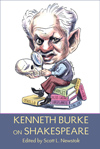 |
Kenneth Burke on ShakespeareKenneth Burke This volume gathers and annotates all of the Shakespeare criticism, including previously unpublished notes and lectures, by the maverick American intellectual Kenneth Burke (1897–1993). Burke’s interpretations of Shakespeare have had an impressive influence on important lines of contemporary scholarship; playwrights and directors have been stirred by his dramaturgical investigations; and many readers outside academia have enjoyed his ingenious dissections of what makes a play function. Artist and illustrator Taylor Jones drew the cover image of Kenneth Burke. |
 |
Essays Toward a Symbolic of Motives, 1950-1955Kenneth Burke In this long-awaited third volume in his Motivorum trilogy, renowned critic and philosopher Kenneth Burke offers his most precise and elaborated account of his dramatistic poetics. |
 |
Late Poems, 1968–1993Attitudinizings Verse-wise, While Fending for One's Selph, and in a Style Somewhat Artificially Colloquial Kenneth Burke The first publication of over 150 poems from Burke's final decades |
 |
Here & Elsewhere: The Collected Fiction of Kenneth Burke Kenneth Burke Here & Elsewhere collects, for the first time in one volume, all of Burke’s fiction. |
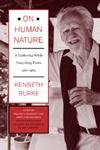 |
On Human Nature: A Gathering While Everything Flows, 1967-1984Kenneth Burke Brings together the late essays, autobiographical reflections, an interview, and a poem by the eminent literary theorist and cultural critic Kenneth Burke (1897-1993). |
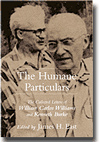 |
The Humane Particulars: The Collected Letters of William Carlos Williams and Kenneth BurkeEdited by James H. East An illuminating conversation between poet and critic |
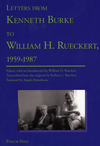 |
Letters from Kenneth Burke to William H. Rueckert, 1959-1987Edited by William H. Rueckert; transcribed from the originals by Barbara L. Rueckert; foreword by Angelo Bonadonna These letters show the development of Burke’s thought in the last thirty or so years of his life, when he remained remarkably productive not only as a correspondent but as a critic and traveling scholar. Rueckert became for Burke both student and “co-conspirator,” with Burke himself playing the roles of teacher, mentor, father, and peer. |
- 62974 reads
Embarking on Burke: Profiles of New Scholars
The future of Burke scholarship is in the hands of young scholars who build on an early interest in Burke and develop research agendas that use Burke’s teachings for critique and that contribute to our unending conversation about Burke and his ideas. To encourage and promote these scholars, we have requested profiles of scholarship from recent graduates of doctoral institutions who focused their dissertations on Burke, and we present more than a dozen of them below in alphabetical order. They come from a variety of fields: art, communication, composition, environmental planning, and literature. We hope that the Burke community will get to know these scholars and their work, seeking them out when putting together edited books, seeking them out when putting together panels for conferences, and seeking them out as co-authors. We have included their contact information to facilitate such scholarly relationships. We encourage them to submit their future work to KB Journal, so that our audience of Burke scholars from various disciplines can become interlocutors learning from and contributing to this scholarly conversation.
Brooks, Ronald Clark. Red Scare Rhetoric and Composition: Early Cold War Effects on University Writing Instruction, 1934-1954. Dissertation: University of Oklahoma, 2004. (Directed by Catherine Hobbs, Department of English.)This work argues that by focusing on the early Cold War period in writing instruction we can more fully understand how remnants of the Cold War shape our own epistemological assumptions. In the field of composition and rhetoric, it is generally assumed that teachers in the fifties operated under the “current-traditional paradigm,” that they were pressured to focus on rhetorical and grammatical principles without considering their cultural context. A closer investigation of this assumption proves that while this argument has some merit current traditional rhetoric played a different role in the academy during the fifties than it does today.
A thorough description and analysis of one of the first academic freedom cases in the early Cold War (i.e., the University of Washington case) helps outline these differences, which are further clarified by looking more closely at textbooks by James McCrimmon, and Cleanth Brooks and Robert Penn Warren; the teaching practices of Theodore Baird and Charlton Laird; the rhetorical philosophy of Richard Weaver; and the published responses to anticommunism by the NCTE. Through the clarification of these differences we are then able to understand, in a more contextualized manner, the unique contributions found in the teaching philosophies of Herbert Weisinger, Albert Kitzhaber, and other scholars at the first meetings of the Conference on College Composition and Communication.
Finally, this contextualization helps us more thoroughly understand the unique contribution of Kenneth Burke’s rhetorical theory. Most rhetoricians in the fifties were forced to either champion the national agenda or work around it in circuitous ways. Brooks and Warren presented a rhetoric that worked with our nationalist agenda. Weaver responded by redefining the terms of conservative versus liberal rhetoric. Burke, more than any other, was able to “transcend” the binaries that the Cold War tried to force on the field. He gave a rhetorically savvy speech to the American Writers Congress in 1935, maintained a Popular Front orientation, and engaged in a more sophisticated form of Propaganda Analysis than did the IPA, but most importantly, his work proved to be very influential for the scholars who helped set the groundwork for the field of rhetoric and composition. In this regard, Burke helps us synthesize the history, pedagogy, and rhetoric of the Cold War period and gives us a way of contextualizing the teaching of writing by paying particular attention to points of disagreement within language and institutional systems.
Ronald Clark Brooks, Ph.D.
Assistant Professor and Associate Director of Composition
Oklahoma State University
ron.brooks@okstate.edu
In environmental planning, the communicative turn has most frequently been represented as requiring more inclusive, honest, and representative communication. Burke’s point that language users may be used by language is relatively new to planning. Particular communicative situations may echo or be structured in relation to larger discursive forms. In my dissertation, I argue for the relevance of communicative forms to planning communication by illustrating the connection between particular, situated environmental planning conflicts and durable communicative forms in environmental literature.
In “Environmental Identities” I characterize three social identities that animate environmental planning and citizenship in the discourses of toxicity, stewardship, and environmental analysis. Individuals are constrained in communication and identity by the communicative forms that are available. Forms are durable, but innovation may occur. I consider the influence of three texts on environmental discourse and the constitution of environmental citizenship: Rachel Carson’s Silent Spring, Aldo Leopold’s A Sand County Almanac, and Ian McHarg’s Design With Nature.
Burke proposed that forms have consequences for action. Forms help to create expectations and attitudes towards the natural world, identities for our selves and motivations for our actions. Using Burke’s dramatism and textual analyses, I show the sources and consequences of the forms of these three texts for the identities and actions of those involved in environmental planning. The social identities expressed through these texts help to constitute important identities of environmental citizenship, including popular movements and professional associations. The way the three texts are applied in discourse shows how the forms embodied in the texts are translated to action.
Narrowly, my dissertation argues that environmental literature influences the particular communicative and local situations of environmental planning. More broadly, my research shows the importance of form in generalizing between communicative situations.
My ‘social identity’ approach integrates the internal form of the Grammar with the identification and alienation of the Rhetoric to propose durable communicative forms as equipment for political living. The contribution of the Rhetoric is of an ‘identity’ as a social distinction that may attract more or fewer adherents. The contribution of the Grammar is as a method of characterizing ‘social identities’ as forms that translate between literature and life. The ‘social identity’ that I propose is a characteristic form that functions as an identity for adherents, that can be dramatistically described, and can be traced in use in both literature and life.
I continue to apply Burkean theories in the realms of environmental planning, thought and education. Currently, my focus is on climate change. Climate change discourse on the whole has been found to be relatively disabling for action, particularly at the local level. Accordingly, I am investigating the discursive forms that allow or enable local governments and citizens to take action to reduce greenhouse gases and increase sustainability. In my current research, I am describing the local social identities that have helped to motivate or enable action.
Tara Lynne Clapp, Ph.D.
Assistant Professor
Community and Regional Planning
Iowa State University
(515) 294-7759
tlclapp@iastate.edu
The advent of computer technology in writing centers has forced administrators, tutors, and clients to reconsider what they do and how they do it. The construction of a new metaphor for online interactions suggests better ways to interact online. To this end, my dissertation develops the idea of the Fluid Cyborg, a combination of the theories of Kenneth Burke and Donna Haraway, as a means to explain and anticipate online tutoring behavior. Burke’s theories providing the critical lens and Haraway’s offer means of reconsidering Burke’s concepts for a virtual age. My intent is to offer suggestions for reconsidering applications of Burke into an area he often rejected: technology.
Doug Dangler, Ph.D.
Associate Director, Center for the Study and Teaching of Writing
Ohio State University
(614) 292-1308
dangler.6@osu.edu
This dissertation is a full-length study of Kenneth Burke’s “Perspective by Incongruity” (PbyI), a concept introduced in his book Permanence and Change (1935). Burke attributes its genesis to his analysis of Nietzsche’s styles; therefore, the content of this study necessarily involves an examination of Burke’s Nietzschean intertext. As Debra Hawhee once asserted, Nietzsche is the single most significant influence on Kenneth Burke (especially the younger Burke). Why then, she asked in 1999, is Nietzsche slighted in the discourse universe some call Burke studies?
The terms of Burke’s Pentad thematize four chapters, with the second chapter combining purpose and scene into a ratio.
Chapter two is the foundational chapter, and maps the context that formed Burke’s interest in and exposition of PbyI. This chapter urges a reorientation of Burke as primarily a Nietzschean confronting Marx, while distinguishing his approach from Freud. To illustrate how reading Burke as a psychoanalytic (or Freudian) critic can be misleading, Fredric Jameson’s 1977 critique of Burke is examined.
Chapter three scopes into a close reading of Burke’s introduction of sparagmos. The theme is agency; sparagmos is the instrumental aspect of PbyI. This chapter attends to Burke’s juxtaposition of images, often clustered incongruously, in his text on Nietzsche and sparagmos. Sparagmos is aesthetic, rather than anaesthetic, because it refers to felt language.
Chapter four belongs grammatically to the term act. Burke freely enacts instances of PbyI in his only novel, Towards a Better Life. This chapter examines Burke’s rhetorical modes (his Six Pivotals), according to which he constructed this text. The key mode is invective; but, invective, being impious, is related to PbyI. Published in 1931, Burke felt this novel would determine his success or failure in the arts. When the book fizzled, he turned to literary criticism and philosophy.
The novel’s theme and some of its formal attributes share a great deal with those of French modernists like Valéry and Huysmans. The primary motive of this chapter is to relate the key rhetorical mode to the theme of the work.
Chapter Five takes up the only remaining term: agent. This chapter surveys Burke’s position on subjectivity through various sources, but focuses on two of his better-known critical efforts on Keats and Coleridge. Burke’s agent term and its subcategory, the subject, are examined through his approach to the author/subject. His perspective on human subjectivity is decidedly Nietzschean, due to his focus on physiology’s decisive involvement in symbolic production.
Conventionally, KB is assumed to be a Freudo-Marxist literary critic. Reading Nietzsche back into Burke’s texts reinvigorates them by forcing a re-evaluation of his theory of language, and his relationship to psychoanalysis and Marxism. Nietzsche’s influence explains many of his seemingly idiosyncratic comments in essays, especially those of literary criticism. Burke remained fixed on the role of the human physiology and its relation to symbol-using.
Gary Scott Groce, Ph.D.
Assistant Professor
Black Hills State University
(605) 642-6040
garygroce@bhsu.edu
This dissertation is the basis of a forthcoming book entitled Race and Reconciliation: Redressing Wounds of Injustice (Lexington, 2008). Both begin with the persistent racial divide and Mark McPhail’s diagnosis of racism as grounded in a language of negative difference. I argue that his proposed remedy—rhetoric reformulated in terms of dialogic coherence—amounts to a comic reframing and shares the limitations of Burke’s comic correctives. Racial reconciliation offers a more robust alternative, rhetorically bridging the tragic legacy of racism and comic visions of multicultural harmony through remembrance, apology, forgiveness, and reparation. I rework Burkean frames and logology to develop a theory of reconciliation and apply it to recent racial reconciliation discourse. The dissertation examines a 1999 reconciliation conference in West Africa; the book also explores recent legislative apologies for the enslavement of African Americans.
A survey of multidisciplinary literature suggests that satisfactory reconciliation is tragicomic, combining a clear sense of justice, guilt, and sacrifice with awareness that victimizers and victims inter-depend for redemption, healing, and a “good life.” Reconciliation also discloses a tensional interdependence between agency and truth (which work rhetorically as romantic and realistic frames on reconciliation). Former perpetrators tend to approach reconciliation romantically and comically, victims realistically and tragically. Thus, reconciliation entails reframing through repentance and forgiveness, weaving disparate narratives into a rounded (if incomplete) narrative of injury and restoration. It often draws upon religious narratives and rites to facilitate this hermeneutic work, since they prefigure resolutions to deep moral contradictions.
I incorporate logology, tempered by Paul Ricoeur’s hermeneutic philosophy, to understand reconciliation’s sacred/secular coming-to-terms. Arguing that Burke erred in making Order (rather than Covenant) the basis for the cycle of terms he derived from the Christian metanarrative, I distill a tetrad of constitutive value terms—Justice, Peace, Truth, and Agency—from reconciliation discourse. The tetrad is dia-logological: the terms act upon one another and give rise to hybrid terms (e.g., Restorative Justice). Satisfactory reconciliation embodies/facilitates their emergent conversation, though differently for perpetrators and victims. Perpetrators’ reconciliation discourse should display tragic judgment on very real wrongs done to victims, with commitment to repair the damage; in turn, this may facilitate victims’ work of romantic and comic reframing (forgiveness). While recent state slavery apologies disavow being a basis for reparation lawsuits, they do demonstrate a significant shift toward thorough, regretful acknowledgment in a tragic frame. As such, they contribute to the possibility of legislative reparations and racial reconciliation.
See also John B. Hatch, “Reconciliation: Building a Bridge from Complicity to Coherence in the Rhetoric of Race Relations,” Rhetoric & Public Affairs 6 (2003): 737-64 (with forum responses by Erik Doxtader, Kirt H. Wilson, and Mark Lawrence McPhail in issue 7:3), John B. Hatch, “The Hope of Reconciliation: Continuing the Conversation,” Rhetoric & Public Affairs 9 (2006): 259-77, and John B. Hatch, “Beyond Apologia: Racial Reconciliation and Apologies for Slavery,” Western Journal of Communication 70 (2006): 186-211.
John B. Hatch, Ph.D.
Wendt Professor / Associate Professor of Communication
University of Dubuque
jhatch@dbq.edu
“The Discourse of Canadian Multiculturalism” examines multiculturalism discourse in Canada through consideration of three influential manifestations of that discourse: the popular press’s treatment of multiculturalism, the federal government’s publications on multiculturalism, and the literary community’s response to the phenomenon in terms of self-identified anthologies of multicultural literature. The dissertation uses three different theories for analysis—dramatism, discourse analysis, and social semiotics—citing their shared emphasis on the social role of language and their perspective on language as a system of options from which language users make choices and produce effects, often unintentionally.
Kenneth Burke’s dramatism, especially the concepts of pentad and substance are used to analyze the Canadian press’s discourse of multiculturalism. Analysis reveals that the press—despite its apparently negative attitude toward topic—actually supports the principles underlying multiculturalism through the ways in which it habitually represents the issue. Specifically, the dissertation argues that, like the discourse of Canada as a whole, the press’s discourse of multiculturalism foregrounds scene, a conservative and stabilizing force for multiculturalism which, as a concept, tends toward fragmentation. In addition, nutritive substance, a minor Burkean term, proves useful in describing and analyzing the way in which this discourse establishes a safe ground, between the detached, acultural possibility of geometric substance and the volatile tribal dangers inherent in the evocation of familial substance. In nutritive substance the external becomes internalized, as the formerly geometric identity of “Canada” becomes part of the hybridized multicultural Canadian’s new identity.
This dissertation applies discourse analysis to government publications on multiculturalism and social semiotics to multicultural literary anthologies, positing connections between these associated theories and discourses.
The Discourse of Canadian Multiculturalism contributes to the field of Burke studies primarily through the dialogue it opens up between Burkean ideas and the more closely allied fields of social semiotics and discourse analysis. Through the extended application of these theoretical approaches from different intellectual traditions, the dissertation suggests new connections—parlor talk in Burkean terms. Also, the relatively undeveloped concept of nutritive substance receives a novel application which may be useful to other researchers.
Using a broad range of methods of inquiry, including dramatism, I (along with my research partner, Dr. Will Garrett-Petts) am currently engaged in a long term investigation into artistic research, especially the artists’ statement.
Rachel Nash, Ph.D.
Assistant Professor, English and Modern Languages
Thompson Rivers University
(250) 377 4965
rnash@tru.ca
This ethnography utilized a conceptual framework of narrative to examine how children with autism and occupational therapists connect to and organize their actions with each other in a sensory integration-based clinic. Data collected over an eleven-month period included narrative interviews with primary caregivers, participant observations, field notes, and videotaping of the dyadic interaction between five preschool-aged children with autism and related disorders, and three occupational therapists. Data analysis and interpretation, including microanalysis of gestures and expressions, underlined how enacted narratives emerge out of actions that create significant and aesthetic moments.
Findings highlighted the agency and narrative practices of intersubjectivity that children embodied to organize their actions and connect to therapists. Drawing from Burke’s Grammar, the study argues that scenic practices include the symbolic acts that (re)create particular sociocultural scenes. The proclivity of such practices challenge DSM-IV diagnostic criteria that children with autism have deficits in narrative competence, imaginary play, or intersubjectivity. Such results underline the utility of narrative as (1) a conceptual framework that embraces embodiment and issues of power in sociocultural structures, and as (2) an intervention for occupational therapy practice focused on sociality and the organization of action across spatiotemporal horizons.
The philosophy of occupational therapy foregrounds individual agency, action and purpose: As Reilly argues: “…[M]an through the use of his hands can creatively deploy his thinking, feeling and purposes to make himself at home in the world and to make the world his home.” Thus, a key tenet of Burke’s Dramatism—humans act while objects are in “mere motion”—is highly relevant to this healthcare practice that utilizes activities as a medium of change. A focus on how to motivate individuals to action when they face the contingencies of illness experiences or a disability status is both pragmatically necessary and rhetorically useful for distinguishing the work of this rehabilitation profession from the “biomedical model,” which treats bodies through drugs and surgery. Beyond such rhetorical similarities, Burke’s Dramatism was also relevant to data interpretation and analysis—both verbal and participant observations. For example, the “dramatistic screen” provided a way to understand the limits of the various terministic screens that guided the actions of the occupational therapists. Further, the structure of clinical interaction is not only shaped by circulating metaphors, such as a journey, but also dramatic as providers and clients seek to create significant experiences.
Forthcoming articles and book chapters for anthropology, occupational science, and occupational therapy audiences will apply the following inter-related Burkian concepts: (1) symbol use, (2) the scene-act ratio, (3) the entanglement of aesthetics and ethics, and (4) attitudes as incipient acts, in order to deepen understanding of how narrative practices shape transformation and healing. Further, Burke’s analogies between dramatic structures and embodied experiences (i.e. appetite, walking, breathing) have threaded through the development of a conceptual model on “embodied metaphors,” that in the spirit of dramatism, aims for a yes-and comedic approach to the stances and terms that guide treatment evaluation and efficacy.
Melissa Park, Ph.D.
Postdoctoral Fellow
University of California at Los Angeles-Semel Institute
mmpark@ucla.edu
My argument in this dissertation is that artworks made in New York between 1958 and 1965, the heyday of color-field painting, minimalism and pop art, comprise different responses to the perceived crisis embroiling advanced art at the time—namely, the threat of misinterpretation posed by a rapidly expanding consumer audience. It is possible to see the general concern over art's relation to its audience in terms of a crisis of metaphor; pivotal innovations during this period, especially in painting, mark a move beyond metaphor in search of alternative modes of address. These different modes can be characterized using the categories provided by rhetorical analysis, in particular the schema of the four master tropes as expounded by Kenneth Burke. For example, color-field painting can be thought of as synecdochic, minimalism as metonymic, and pop as ironic. All three offer strategies to ward off misappropriation: the first by disallowing any interpretive leeway, by shoring up all space between viewer and painting so that the encounter seems to happen within "eyesight alone," in the intimate proximity and instant of looking; the second involves giving the artworks over to viewing while also steeling them against it, so that only obdurate surface and irrefutable fact is presented; and the third involves artworks that advance more than one meaning, thus undercutting the authority of any one over another. By 1965 interchange between these modes comes to a halt, as arguments emerge that make differences between artistic viewpoints into stark polarities. Naming abusive acts of viewing each required an interpretative act of its own, which proved the self-same poetic essence of art to be a construction, one needing the advocacy and arguments of rhetoric.
Since the dissertation I continue to use Burke's understanding of tropes as fluid modalities to try to pry apart and make relational and interactive synecdoche and metonymy, rather than allowing them to be collapsed, which opens the way for the dualism that rhetorical analysis too often gets reduced to - namely, a reduction to metaphor and metonymy. As Genette and others have stressed, it is by means of this reduction that rhetoric has been modernized and subsumed within Saussurian linguistics and mapped onto the paradigmatic and syntagmatic poles of language. Thus simplified, these dyadic terms then get superimposed onto a number of ideological oppositions: between vertical and horizontal, monological versus dialogical, sublimating analogy versus proximal contact, quasi-religious organicist symbol versus scientistic logical sign, the transcendent up-above versus the immanent here-below. Aside from T. J. Clark (who employs metaphor to think through mediations), historians and critics of modern and contemporary art too often follow Rosalind Krauss and the October group in their imposing upon analysis a postmodern standoff between the idealist optical and the materialist index or informe. I believe that, in contradistinction, the tropic schema developed by Burke (and echoed in more recent work on metaphor by Ernesto Laclau and Gayatri Spivak) can help situate analysis of artworks in more complex, heterogeneous social and political discursive formations.
Lane Relyea, Ph.D.
Assistant Professor
Northwestern University
(847) 491-2096
lrelyea@northwestern.edu
Many evangelical Christian readers forget that when reading the Bible, they see only black marks on a white page that gain meaning in the process of socially constructed interpretation. Instead, their perceptions of the nature of the Bible are affected by language-based persuasive devices such as a cluster of sensory metaphors to appeal to “what the Bible has to say” and “what we see clearly” in the text that masks the human agency and room for disagreement in the act of interpretation.
Letha Dawson Scanzoni and Nancy A. Hardesty, authors of the representative text of second wave biblical feminism, All We’re Meant to Be: Biblical Feminism for Today (1992 3rd Ed., Eerdmans), disagree with their counterparts Wayne Grudem and John Piper, authors of the representative text of complementarianism, Recovering Biblical Manhood and Womanhood: A Response to Evangelical Feminism (1991 Crossway), about the role of women in the evangelical church and family. Both sides of the gender role debate use strategies such as the sensory metaphor system, the language of formal argument, personification, and dualisms to persuade their readers that their exegesis of the Bible, a polysemous text, is the one correct truth of Christianity. Evangelical audiences resonate with attempts to disambiguate the Bible into one literalized truth because they share the hermeneutical assumptions of infallibility, plain reading, and unacknowledged human agency that add authority to their interpretations of the sacred text.
Kenneth Burke provides the rhetorical framework to explain the use of literalized linguistic systems in the process of reifying an interpretation into a terministic screen. These rhetorical acts seek to reduce the complexity of the Bible into a singular, simplistic, uniform meaning. Metaphors such as the sensory cluster can be used to close down the meanings of texts, but Burke also argues that metaphors can open up the text for different interpretations. Burke offers a way to challenge exegetical reductionism by seeing the space where text, reader/interpreter, and community interact as a place for multiple, complicated possibilities.
Burke adds theoretical support for the productive critic to advocate for sexual equality by uncovering evangelical rhetoric as interpretive. This symbolic approach to biblical interpretation broadens both the complementarian and feminist terministic screens until they reach consubstantiality, embrace the historical richness of evangelical Christian hermeneutics, and enable a change in the material situation of women in the evangelical churches.
I am preparing a manuscript for William B. Eerdmans Publishing Company with the working title Theapalooza: The Rhetoric of the Next Generation of Biblical Feminism utilizing Burkean approaches to dramatism and metaphor to propose Christian feminist advocacy through rhetorical in addition to theological means, a perspective uniquely emphasized in the third wave of the evangelical egalitarian movement.
Alena Amato Ruggerio, Ph.D.
Associate Professor of Communication and Interim Director of Women’s Studies
Southern Oregon University
Alena.Ruggerio@sou.edu
This study employs Kenneth Burke’s rhetorical theory to examine scapegoating and sacrifice in William Blake’s works from the 1790s. It argues that Burke and Blake are antinomian thinkers who share two major ideas: a belief that scapegoating is pervasive in human culture and that it is intrinsically linked to systems of symbolic order, particularly when those systems become rigid and exclusive. The study also establishes two other major points. It demonstrates the importance of sacrifice and scapegoating throughout Blake’s opus, not just in the late prophecies. It also traces the development of Blake’s ideas about order and sacrifice through the 1790s, from a rejection of order as an unjust and violent imposition on human personality and culture, towards a more Burkean position which recognizes that symbolic orders are unavoidable. In a discussion of The Four Zoas, the study shows Blake striving to create a Burkean dialectic, in which the quest for ultimate values can be pursued in a self-consciously flexible and ever-changing symbolic order.
While the dissertation focuses primarily on a reading of Blake, it contains much to interest a Burke scholar. The first chapter includes a 28-page theoretical overview, which explicates the relationship between scapegoating and symbolic order in Burke by synthesizing material from A Grammar of Motives, A Rhetoric of Motives, and The Rhetoric of Religion, as well as other Burke texts. Each chapter includes one or more segments exploring how specific Blake texts treat scapegoating and symbolic order as compared to Burke. Ultimately, the project is significant for Burkeans because it provides a reading of Burke that highlights his ideas about dialectic as a means of curbing the scapegoating motive and his importance as an antinomian thinker who does not engage in unrealistic attempts to reject order altogether.
My recent research includes an article, “The Romantic in the Attic: William Blake’s Place in Kenneth Burke’s Intellectual Circle,” to appear in Jack Selzer and Robert Wess’s book, Kenneth Burke and His Circles, forthcoming from Parlor Press. This article examines the references to Blake in Kenneth Burke’s novel Towards a Better Life and in The Rhetoric of Religion. At CCCC in 2007, I presented a paper entitled “Kenneth Burke and The End of Faith: Religion in an Age of Terror,” which compares the rhetoric about religious violence in Sam Harris’s book The End of Faith to Burke’s approach in The Rhetoric of Religion. At the upcoming Kenneth Burke Triennial Conference, I will continue with the theme of religious violence in a paper entitled “Transcending Sacred Violence: Perspectives on Burke and Girard.” Within the coming year, I plan to revise and submit for publication both the CCCC presentation and a dissertation chapter on Burke’s scapegoating theory in Blake’s The Book of Urizen.
Laura E. Rutland, Ph.D.
Assistant Professor of English
Gannon University
(814) 871-7532
rutland001@gannon.edu
This dissertation analyzes the persuasive strategies of the early Florida “truth” anti-tobacco campaign through a Burkean lens. The campaign’s rhetorical move from an anti-smoking to an anti-tobacco approach appeals to youth by redirecting youthful rebellion toward the tobacco industry. By developing a campaign that opposes the tobacco industry, the “truth” campaign shifts the locus of responsibility from the individual smoker (mortification) and places the blame with the tobacco industry (scapegoating). This dissertation argues that the campaign’s anti-industry message resonates with youth because it constructs its audience in a manner that coincides with the way they see themselves, as competent young people who can make informed decision on their own behalf. Several types of mediated texts from the first two years of the “truth” campaign were analyzed, organized by media type. Chapter two criticizes television commercials, chapter three analyzes “Secrets,” a two-minute film trailer that was released in theaters and on television, and chapter four examines the earliest “truth” website.
At the heart of the analysis is an argument that has been put forth by other rhetorical critics: given the option of placing blame on ourselves (mortification) or others, we prefer to place the blame somewhere else (scapegoating, transcendence). The efficacy of structuring the “truth” campaign as an anti-tobacco campaign is that whether or not young people smoke, they can lash out at a corporate entity that has profited from death, disease, and addiction of others. Other key Burkean terms that animate the analysis include identification, synecdoche, and hierarchy.
In several of Burke’s critical essays that employ scapegoating, such as the “The Rhetoric of Hitler’s Battle,” the group that is scapegoated is innocent. This leads to the question, is it still considered scapegoating when the individual or group, in this case, the tobacco industry, is actually guilty? This dissertation argues that it is scapegoating, despite the innocence or guilt of the party that is scapegoated. Relying on the “pseudoscientific” type of scapegoating, the “truth” campaign projects ills onto the tobacco industry, without considering the kinds of impact family members, peers, celebrities, or other groups may have. Scapegoating is envisioned as a framework that emphasizes the guilt of an external group without addressing whether that guilt may be shared by others.
This rhetorical criticism draws from Burke, rhetorical critics relying on Burke’s writings, health campaign research, and writings on the rhetorical audience. The key concepts from Burke’s writings revealed how the campaign functioned as both a youth-oriented health campaign and an anti-corporate rant. Burke’s explanation of an audience’s motives partnered very well with social scientific research that addresses the kinds of messages that persuade young audiences. This research reinforces its application to the understanding of health campaigns and anti-corporate rhetoric.
The third chapter of this dissertation, which analyzed a two-minute film trailer, will be published in the Spring 2008 edition of the Florida Communication Journal under the title, “Secrets [of a Tobacco Executive]: Using Burke to Reveal the ‘truth’.”
Mary Pelak Walch, Ph.D.
Assistant Professor
Florida Gulf Coast University
(239)590-7149
mwalch@fgcu.edu
"What am I but a word man?" While Kenneth Burke's work on human relations, A Grammar of Motives, has most often been discussed in relation to other possible generating or derivational theories, or in its pedagogical potential, Burke's own approach, beginning with a grammar before attempting his planned rhetoric and symbolic, argues for a more ontological method, and one based in language theory. My dissertation offered an extended analysis of Burke's public and private writing just prior to and during the Second World War—work that led to both The Philosophy of Literary Form (1941) and A Grammar of Motives (1945)—as rhetorical action emerging from and responding to the conversations of his circle of "word men" as they confronted the problematic role of art during war.
In the Introduction, I argue that Burke came to his understanding of dramatism in part because of his increasingly critical dialogue with those who would become the first generation of New Critics—Allen Tate, Robert Penn Warren, Cleanth Brooks, R. P. Blackmur, I. A. Richards, John Crowe Ransom. Chapters One and Two place Burke in the midst of the "literary wars" between Esthetes and Marxists and show how The Philosophy of Literary Form proposes a "battle plan" for poets and critics to diagnose society through literature. Chapters Three and Four analyze the pressures exerted by the Second World War and Burke's response: A Grammar of Motives that detailed a methodology to understand the ambiguities of motivation and so to transcend physical divisions with language-based mergers. The Grammar aimed to "purify war" not by opposition but by ironic transcendence.
I conclude by analyzing why the Grammar failed to achieve its hoped-for goals in the immediate post-war years and why this moment may be a more propitious time to reexamine Burke's vision—to recontextualize his rhetorical scene in order to shed light on our own.
Burke is absolutely central to this extended study of dramatism, as is the rhetorical theory he promulgated in A Grammar of Motives. However, it is not a historical study as much as an argument for the manner in which dramatism developed as, first, a conversation among the literary critics of the day and, second, as a conversation whose focus was, more often than we commonly acknowledge, the Second World War and the various intellectual responses possible to it.
In the dissertation, I began to make the argument that a full understanding of dramatism would need to see it as both a kind of new criticism variant and as a response to war. I argued specifically that this new critical war response was most fully realized not in the pentad alone but in the whole trajectory of A Grammar of Motives, from presentation of a methodology for linguistically transcending war to exploration of the consequences of—and hortatory plea for—such symbolic action. To do so, I examined not only the Grammar and Philosophy of Literary Form, but Burke's public/private conversations with the so-called "word men" of his time, considering his writing always as a materially contingent response to an ongoing dialogue and including a variety of lesser-studied works in the Burkean corpus, including particularly his wartime work for the Popular Front journal Direction. My purpose was to engage rhetoricians in a two-pronged reexamination of their position in the academic community—first as colleagues with their literary/theorist compatriots and second as engaged intellectuals in a world at war.
My book Burke, Words, War: Rhetoricizing Dramatism is due out from the University of South Carolina Press this fall (2008). It extends dramatically the work of the dissertation by vastly increasing the research, more strongly honing the argument, and examining more closely the implications of my own methodology in undertaking this study—arguing that "rhetoricizing" a universally applied theory such as dramatism can yield insights from its historically contingent origins which enrich—or even alter—our use of the theory in the present. The book is also just much better written.
An article based on my book research, "Burke and War: Rhetoricizing the Theory of Dramatism," Rhetoric Review 26.3 (2007): 286-302, was awarded honorable mention for the Theresa J. Enos prize for best articles of 2007. My co-authored article "Beyond a Rhetoric of Shame: The Dialogic Narrative and Comic Correction," JAC 27.3 (2008, forthcoming), uses Burke's comic corrective to explore (with a psychologist and a creative writer) the pedagogical potential for a more dialectical approach to the personal narrative. My article "Rene Wellek and Kenneth Burke: Prague Influences on Modern Rhetoric," forthcoming from Litteraria Pragensia, considers the impact of Rene Wellek's 1942 article "The Mode of Existence of a Literary Work of Art" on Burke's discussion of the intrinsic/universal and extrinsic/historical duality in literature—an eventual key consideration in his dramatistic understanding, and a cornerstone of my own approach to "rhetoricizing" theory. I am finishing articles within the next six-eight months on Allen Tate's role in the scope and reception of Burke's Grammar, Burke's philosophical stance of "falling on the bias" across arguments, and—as an extension of my book—the conversations swirling around Burke's development of identification in A Rhetoric of Motives. Then I'm turning to something completely new and beginning a book on communal identification through national museums.
Elizabeth Weiser, Ph.D.
Assistant Professor, Rhetoric, Composition, and Literacy
The Ohio State University
weiser.23@osu.edu
The concept of identification—the “key” term of the “new” rhetoric—is perhaps one of Kenneth Burke’s most well-known and appreciated contributions to rhetorical theory and criticism. Current understandings of Burke’s identification have oftentimes conceived of this “key” term through the restricted lens of the “old” rhetoric. In an attempt to clarify identification’s role in the “new” rhetoric, this study traced the evolution of Burke’s thinking on the subject of identity from his first major work of non-fiction, Counter-Statement (1931), and through the more mature discussion of identification and division culminating in A Rhetoric of Motives (1950) and “Rhetoric—Old and New” (1967).
The central lesson drawn from this project is that the “key” term of the “new” rhetoric is not an abstract and unchanging concept. Specifically, Burke’s preoccupation with “health” and “sickness” served as a blueprint for the development of his hyper-critical attitude necessary for the artist as citizen keeping watch over the “health” of his/her interpretations and participation in a “diseased” culture. When applied beyond the context of literature, Burke’s concepts of identification and division provide a prescriptive social vocabulary concerned with the “health” of our interpretations as evidenced in the proper governance of the self acting in society.
What distinguished Burke from other artists and thinkers early in the twentieth century was his translation of the artist in the image of the hypochondriac. Throughout his life (as evidenced in published and unpublished writing and correspondence from the Burke Collection), Burke demonstrates a preoccupation with “health” and “sickness.” Whereas hypochondriacs concerned themselves with incipient forms of illness and disease in the body, the artist, according to Burke, would seek out incipient forms of disease in culture to unearth disorders of social thought and belief. As such, the hypochondriacs’ “professional vigilance” and persistent doubt normally reserved for the context of physical “health” served as the model for Burke’s emerging conception of the role and function of the artist in society.
Given Burke’s preoccupation with “health,” a reexamination of other key terms in Burke’s corpus thought to be associated with the “old” rhetoric assume new and important significance when analyzed and understood using the lens of “health.” For example, Burke’s articulation of the “comic” frame using the principles of homeopathy illustrates his concern not with eliminating disease, menace, uncertainty, etc., but with how, as artists, we can translate the “poisons” of participation into creative opportunity and insight.
Finally, this study investigated the importance of “division” in the “new” rhetoric as an essential, but often overlooked, interpretative tool that allows for analyses beyond the lens of “strategy”. When viewed as necessary ingredients in a “dialectic of health,” identification and division provide for a complete and necessary social vocabulary from which participants in society can “draw lines” between cooperation and exploitation and “health” and “sickness.”
Zachary White, Ph.D.
Visiting Assistant Professor
University of Tulsa
(918) 631-3466
Zachary-white@utulsa.edu
One of the lasting contributions of Kenneth Burke is his dedication to widening our preconceived notions about the range and scope of rhetoric in everyday life. Burke expands the study of rhetoric by situating the rhetorical motive in the ordinary events and experiences of everyday life such as magic, myth, religion, and bureaucracy. Burke broadens the range of what we recognize to be rhetoric through his understanding and explanation of “identification.” His expressed goal, he states in A Rhetoric of Motives, is to use identification to show “how a rhetorical motive is often present where it is not usually recognized, or thought to belong” (xiii). Identification, put simply, occurs when a person’s interests or motives appear to correlate with another person’s interests or motives. We become, in Burke’s terminology, consubstantial. Yet, I argue, Burke “uses” the concept of identification to examine three different, although not entirely distinct, ways that identification is relevant to our analysis of everyday interactions. First, identification, exemplified in consubstantiality, is used by Burke to describe a universal characteristic of human interaction. Second, the concept of identification is used to name certain strategies of persuasion. Third, the dual role of identification as a universal characteristic and potential strategy for persuasion also allows for its use as a means of analysis. What can inform our understanding of Burke’s work, and rhetoric in general, is the recognition that each of the three uses of identification implicates and informs the other. When we begin with one, we encounter the other. However, intersecting Burke’s work with other contemporary theorists that study rhetoric and identity can be useful for illuminating both. In this case, I have chosen to focus on the work of Calvin O. Schrag.
Calvin Schrag’s theory of communicative praxis allows us see the three uses of identification from a different, yet not incongruous, perspective. Schrag’s articulation of the relationships among communication, subjectivity, and consciousness becomes the backdrop for an examination of the three uses of identification. Since identification and consubstantiation are so closely linked to identity, Schrag’s explication of the “decentered subject” offers a terminology and perspective that emphasizes the elements of both phenomenological and postmodern theory. Specifically, Schrag’s analysis of the “subject” in relation to the concepts of transversality, the chronotope, and the “fitting response” provides us with one way to explicate further the three uses of identification and see how is interrelated. The guiding research question address is, “How is an understanding of Burke’s three uses of identification informed by Calvin Schrag’s theory of communicative praxis?” In the end, for Burke, it is critique and for Schrag it is questioning that helps us gain a perspective on the experience of identification while also providing a means for making sense of the moral import of our actions.
Thomas S. Wright, Ph.D.
Instructor, Dept of Strategic and Organizational Communication
Temple University
Phone:
(215) 204-1886
tswright@temple.edu
- 65004 reads
Kenneth Burke on Myth: An Introduction, by Laurence Coupe
Coupe, Laurence. Kenneth Burke on Myth: An Introduction. New York and London: Routledge, 2005. 206 + xiv. $85 (cloth).
Reviewed by Daniel L. Smith, University of South Carolina
KB Journal 2.1 (Fall 2005)
“Arche men oun kai hoion psuche ho muthos tes tragoidias.” — Aristotle, On Poetics (1450a38)
Aristotle’s observation that mythos (better translated as “story” rather than “plot”) is the first principle of tragedy encapsulates one of the vital problematics of Kenneth Burke’s dramatism and logology. Specifically, naming story as the “first principle” of tragedy captures one of the central ambiguities of Burke’s thought. For in identifying a temporal phenomenon as an arche—i.e., a principle “logically prior” to the temporal, according to Burke—Aristotle’s statement renders questionable the boundary between transcendent principles (archai) and the temporal events that “follow from” them. Spanning virtually his entire career, one can witness Burke’s search for a transcendental ground upon which to construct a framework for understanding human existence, with its profoundly symbolic dimensions. This ground takes various forms in his work: “innate forms of the mind” (Counter-Statement, 46); the “permanent certainties of the body” (Permanence and Change, 52); and Burke’s identification of a “grammar” that is “logically prior to both the rhetorical and psychological” (A Grammar of Motives, xviii). These formulations, and others in Burke’s oeuvre, signal a quasi-Kantian sensibility at work. That is to say, Burke sought to identify transcendental a priori conditions of possibility through which to understand the concrete, historical dimensions of humans’ socio-symbolic ways of life. However, at the same time, Burke’s commitment to recognizing the very real complexity and contingency of history and human culture precluded identifying logically prior principles that operate in a strictly deterministic fashion (à la Kant’s transcendental aesthetic). Burke’s transcendentalist proclivities had to work in concert with his sensitivity to the mutability of language and life and the accompanying dynamism of history. Burke’s dual commitment to the transcendental (permanence) and the historical (change) is at the root of the indeterminacy in his work between logically prior conditions of possibility (“principles”) and their temporal act-ualizations. Within and among Burke’s particular works the degree of his commitment to each perspective moves between the two, and thus at times inhabits the liminal or indeterminate space between them.1
Laurence Coupe’s Kenneth Burke On Myth: An Introduction goes a long way toward highlighting the importance, and attendant difficulties, of this dual commitment in Burke’s thought by placing myth at its center. Coupe provocatively asserts that “the unifying theme in all of [Burke’s] work is the meaning of mythology” (3). The significance of Coupe’s thesis with respect to Burke’s dual commitment is evident in the introductory claim that “[m]ythology for Burke is at once historical and universal, temporal and transcendent” (4). Coupe also notes that “Burke’s preoccupation with language cannot be divorced from his preoccupation with mythology. For him . . . logos and mythos go hand in hand” (5). He closes his introductory remarks with his own formulation of a Burkean definition of myth: “A narrative that effects identification within the community that takes it seriously, endorsing shared interests and confirming the given notion of order, while at the same time gesturing toward a more comprehensive identification—that among humanity, the earth, and the universe” (6). Coupe’s Burke-inspired definition prompts a question: How does a community within which narratives can be taken seriously and effect identifications emerge or take form? Put differently, what is the genesis of “the given notion of order” that a particular myth confirms or the “shared interests” it endorses? In short, does placing myth at the center of Burke’s thinking set the mythical cart before the communal-symbolic horse, as it were?
Following his introductory remarks, Coupe performs a virtuoso reading of Burke that spans five chapters. In Chapter 1, “Myth and Society,” Coupe examines two texts, “Revolutionary Symbolism in America” and “Ideology and Myth.” Coupe emphasizes that myth, for Burke, cannot necessarily be equated with falsity. Indeed, Burke contends that myths perform very real social functions, promoting and/or sustaining various forms of communal life and their corresponding modalities of social relations and matrices of meaning—regardless of their “truth” or “falsity.” One may be tempted to think that myth, here, is simply a synonym for ideology. Coupe, however, argues that Burke’s theory of myth is not reducible to ideology; that “the two are not the same thing, though they frequently appear to overlap” (9). He discerns in Burke the idea that myth can have an “ideological function appropriate to the given historical conditions, but it also has a universal dimension that is transhistorical” (11). According to Coupe, myth, unlike ideology, valorizes an ideal of absolute unity and inclusion, while ideology does not idealize the total dissolution of factionalism and division. Indeed, for Coupe, ideology is dependent upon division. One of the defining features of ideology, therefore, is the “us-them” dynamic.
Thus the overlap between myth and ideology—as Coupe reads Burke—lies in the ways ideologies use the mythic ideal of unity, but do so in a manner that is not all encompassing. Inasmuch as ideology depends upon and attempts to realize historically the mythic principle of unity—albeit in a limited way—Coupe contends that “myth precedes and informs ideology” and then cites Burke, who claims that “we may treat the mythic as the non-political ground of the political, not as antithetical to it, but as the ‘pre-political’ source out of which it is to be derived” (17, my emphasis). Of course, how “the political” is conceptualized is connected to what is considered non- or pre-political; what is at work here is the notion that the pre-political is intimately connected to our human condition as divided beings. That is, as Burke puts it in A Rhetoric of Motives (RM), “there is a generic divisiveness common to all men [that] is a universal fact,” which transcends history and culture (cited in Coupe, 25). This pre-political condition of division is also identified by Burke in RM as “the basis of rhetoric” (cited in Coupe, 25).
Implied by this is the idea that myth is among the first forms rhetoric takes, and thus to understand the mythic roots of rhetoric and the rhetorical operations of myth one cannot ignore, as Coupe notes in Chapter 2—“Myth and Literary Criticism”—the formal principles of narrative (31). What needs to be understood here works at the level of principle, and thus cultural and historical accounts of myth’s origin and power are insufficient—transcendental conditions of possibility must be identified. This explains why, as Coupe proposes, that Burke identifies the origin and power of myth in the intrinsic nature of language itself, rather than in the particular historical circumstances of a given culture or community. For Coupe, the principles of language providing insight into myth are “the negative” and the motivational force of entelechy.
Coupe is right to turn to the negative and entelechy in his attempt to theorize a Burkean conception of myth, given their centrality in Burke’s work. However, the move from the negative to entelechy is made rather quickly, and Coupe’s argument would have been well served at this point if he had taken more time to discuss the negative more systematically, particularly with respect to its connection to “the entelechial principle” (46). For example, missing from Chapter 2 is any discussion of identification and consubstantiality, both intimately linked to the negative, and their relation to the ways in which symbols work to “transcend” the division that is humanity’s “natural” condition via acts of unification. To the extent that myth, as Coupe submits, must be understood as having its motivational roots in the pre-political state of dividedness, a discussion of symbolic mechanisms for transcending division—and their tie to the negative—it seems to me, would be essential to Coupe’s project.
The absence of such a discussion at this point in Coupe’s argument compels me to ask if his desire to put myth at the center of Burke’s thought leads him to miss aspects of Burke’s thought that complicate his thesis. More specifically, while there are places in Burke’s corpus that suggest myth is the pre-political source of politics, and therefore “precede and inform” their ideological dynamics, there is, I think, more evidence in Burke’s body of work to suggest that the symbolic formation of communities and their political dimensions would have to precede and inform any myths that emerge as fundamental symbolic aspects of those communities. In other words, can myth and politics/ideology be a readily distinguished in Burke’s thought in the manner Coupe argues? A thoroughgoing consideration of the negative (and thus the paradox of substance) would, I suggest, bring such easy separation into question. And although Coupe acknowledges that myth is both transcendent and temporal, and periodically reminds his readers of the bond between the two, the former is unduly privileged over the latter. Whether the priority of the transcendental is as consistently at work in Burke’s thought as Coupe’s monograph implies is arguable.
In fairness to Coupe, however, these lines of criticism are, in a sense, quite un-Burkean. For of the many lessons one can learn from Burke, among them is the productiveness of deployments of other thinkers’ ideas that are not bound by piety. It’s not difficult to identify numerous occasions where Burke is “wrong” about the ideas of Nietzsche, Freud, Aristotle, and Spinoza (to name only a few). But such criticism presumes that Burke’s style of engaging thinkers was primarily concerned with being “right” about or accurately representing their ideas, rather than staging dramatic encounters with them. Within these encounters Burke was able to coax forth concepts connected to other thinkers but at the same time diverged from or extended them in creative and inventive ways (ways that “pious” followers would likely shun). This is not to say, though, that Burke was simply unconcerned with what thinkers actually said or meant. To the contrary, Burke’s creative engagements with other thinkers required an attunement not only to the content of their ideas but also to the rhythms of thinking that composed them. Burke entered into and played (along) with these rhythms, transforming an encounter between two or more discrete thinkers into a singular composition of potentials for conceptual improvisation. And while Coupe’s explanations of Burke’s thinking are informative and insightful, though debatable at times, ultimately what is most interesting and thought provoking about his project is what emerges from his ability to play (along) with Burke in this inventive manner.
In Chapter 3, “Myth and ‘Ritual Drama’,” Coupe explores Burke’s “dramatic” conception of social relations, leading him to Burke’s thoughts on ritual, magic, piety, and narrative. Especially illuminating are the insights into myth generated by Coupe’s deft articulation of the connections and dynamics among these concepts and Burke’s idea of form, culminating in a discussion of “ritual drama” as the “Ur-form” composing social relations (78). Chapter 4, “Myth and Victimage,” covers a theme essential to Burke’s post-Grammar work: the social operations of scapegoating. Here, unlike Chapter 2, the important role of the negative is briefly examined, particularly with respect to its functions in the dynamics of order, guilt, redemption, and victimage. Perhaps the most creative of Coupe’s efforts can be found in Chapter 5, “Myth and Ecology.” As the chapter’s title suggests, the concept of ecology is folded into Coupe’s Burkean theory of myth. However, unlike the concepts of, say, consubstantiality or ritual drama, which inform Burkean theory’s understanding of how myths operate, ecology should be seen as part of the comic sensibility Burke brings to bear in response to the destructive possibilities of our own “push to perfection” that works with the greatest intensity in and through myth.
At the heart of Coupe’s ecological framing of Burke is the connection highlighted between Burke’s concern with the Greek term hodos—understood by him as “the Way”—and its Eastern counterpart of “the Way,” the Tao. Coupe foregrounds the Tao’s emphasis on living in attunement and harmony with nature; thereby identifying in the Tao what can be described as an ecological ethos rooted in what Coupe calls the “norm of nature” (148). Ever the Burkean, however, Coupe complicates the notion of nature by folding together Taoist ideas about being’s inextricable immanence with non-being and Burke’s thoughts on “nature” and “supernature.” What results is a conception of nature that is in many ways ambiguous and indeterminate. Coupe therefore eschews “the notion of a permanent, transcendent Nature [that] has been used over the centuries to justify the social status quo and some dubious cultural assumptions” (163). While “Burke’s instinct is to seek permanence amidst change” (146), the permanence implied by a Taoist-“supernatural” norm of nature, Coupe argues, leaves little room for the “technological psychosis” and hubristic anthropocentrism that has characterized Western culture for quite some time. The attributes of this paradoxical “norm of nature,” which Coupe also describes as “transcendent and permanent” (148), is too complex to summarize and comment upon here. I encourage readers to consult Coupe’s text to explore this norm and consider its implications.
One of the most intriguing parts of this final chapter is Coupe’s suggestion—one carried over into the book’s conclusion—that Burke himself can be considered a mythmaker, and that the rhetorical re-iteration and performance of myth can be a viable form of transformative social action. Coupe’s Burke-inspired ideas about the transformative potentials of myth embraces the para-religious dimensions of Burke’s thought, something avoided by many Burkeans. He doesn’t describe it as such, but Coupe extracts from Burke’s corpus what might be called a comic religiosity, which is quite open to learning from Eastern and Western religious and spiritual traditions but at the same time makes it quite difficult for its “followers” to be self-righteousness or dogmatic. Whatever readers of Coupe’s book may think of the content of its argument—and there is substantial content to engage—it is difficult to deny that Coupe’s project performs for us something all too rare in Burke scholarship: the embodiment of Burke’s “impious” and comically religious spirit. And this, finally, is what makes Kenneth Burke on Myth a must-read.
Notes
- Following Robert Wess, we might describe this liminal space as “transhistorical,” in contrast to the transcendental or the historical. See Wess, Kenneth Burke: Rhetoric, Subjectivity, Postmodernism (1996), 13–28. For the sake of clarity, it should be noted that in Coupe’s text, unlike Wess’s, the transcendent and the transhistorical are synonymous.

This work is licensed under a Creative Commons License.
- 36145 reads
Kenneth Burke on Shakespeare, by Scott Newstok
Newstok, Scott L., ed. Kenneth Burke on Shakespeare. West Lafayette, IN: Parlor Press, 2007. lv + 308 pp.
Reviewed by Andrew Battista, University of Kentucky
In a recent Times Literary Supplement commentary, Peter Holbrook speculates why Kenneth Burke, once a “hip literary intellectual,” has since been removed from academia’s tightly-policed list of influential critics. Holbrook argues that Burke’s novelty as a literary critic and rhetorical theorist has all but dissipated in today’s intellectual milieu, where Burke’s insights have “become the shopworn stock of literary and cultural study everywhere.” Basically, Burke is old news. As Holbrook sings his swan song, he also has some unsavory things to say about Burke as a stylist and thinker. Burke is, in Holbrook’s view, a disengaged critic whose prose betrays him as a “woefully slapdash and charmless writer,” a theorist whose ideas are exceedingly “thick with the fumes of a proliferating and autogenic terminology” while lacking a clear import or sense of urgency (11-12).
However, even as he dismantles Burke, Holbrook would admit that Burke’s more innovative and lucid moments come when he engages the works of William Shakespeare, the playwright who provides Burke with ideal texts to explicate his notion of Dramatism. We know from one of Burke’s foremost expositors, William Rueckert, that Burke entertained the idea of publishing a volume of his own work on Shakespeare, but such a project never came to fruition during Burke’s life (266). Thankfully, now we have Kenneth Burke on Shakespeare, a collection edited by Scott L. Newstok that compiles the entirety of Burke’s writings on Shakespeare, including three previously unpublished lectures.
The most valuable of these, Burke’s talk, “Introduction: Shakespeare Was What?,” serves as a useful primer to Burke’s system of reading Shakespeare. As the lecture establishes, Burke is ultimately concerned with what literature does (i.e. how it functions). Accordingly, Shakespeare is, in Burke’s mind, an artist who “spontaneously knew how to translate some typical tension or conflict of his society into terms of variously interrelated personalities.” As Burke explains, Shakespeare’s ability “was to let that whole complexity act itself out, by endowing each personality with the appropriate ideas, attitudes, actions, situations, relationships, and fatality” (18). Shakespeare, above all other dramatists, constructs plays in which his characters’ engagements with each other constitute the play’s movement while dictating meaning to its audience. And Burke, perhaps above all other critics, articulates the anatomy of these engagements for us.
Newstok places Burke’s “Introduction” before the essays on the individual plays in the volume, and he directs the uninitiated reader to digest Burke’s lecture before tackling the extended meditations that follow it. Newstok also prefaces the volume with an extremely well-written introduction that not only contextualizes Burke as a literary critic and Shakespearian, but also provides a Dramatis Personae, a guide to the sometimes-foreign Burkean nomenclature that undergirds his readings. Those encountering Burke for the first time will benefit from Newstok’s accessible delineation of central Burkean concepts, like “entelechy,” “ritual,” and “paradox of substance.” Newstok’s introduction not only offers a primer to the essays at hand, but also provides a useful situating of Burke as a “maverick intellectual” (xvii) who often tested the stylistic conventions of literary criticism in the American academy and who always remained aloof from the mainstream establishment.
The highlights of Kenneth Burke on Shakespeare include its essay on Julius Caesar, in which Burke ventriloquizes the oft-repeated “Friends, Romans, Countrymen” speech, surely one example of his ability to reshape the form of academic criticism; and Burke’s explication of Othello, which Newstok calls “by far [Burke’s] most ambitious contribution to Shakespeare studies” (xxvi). In this essay, held as a model that illustrates his method, Burke systematically explicates how the tragedy functions. Throughout Othello, Burke argues, Iago serves as an impresario, goading “the plot forward step by step, for the audience’s villainous entertainment and filthy purgation” (69-70).
Newstok edits with great scrupulousness, and the information concerning the textual origins of Burke’s writing far exceeds what one would expect in such a volume. Newstok provides ample rationale for his editorial decisions, useful information on each essay’s original publication, and generally helpful references to Burke’s allusions to Shakespeare. Unfortunately, though, many of Newstok’s endnotes, which aim to make Burke’s criticism accessible to scholars and general readers alike, verge on being obtrusive. For instance, when Burke makes a reference to Plato, it’s somewhat frustrating to flip back to the endnotes and read that Plato (c. 427 BCE—c. 347 BCE) was a Greek philosopher (267). To be fair, Newstok acknowledges the quandary of annotating for multiple audiences, and he warns that many of his endnotes will be “comically redundant for some” and still “not enough information for others” (liii). Regardless, in many instances it’s hard to imagine who these others might be.
Nonetheless, Burke scholars will find Newstok’s compilation of additional references to Shakespeare invaluable. While the sections that Newstok provides can’t possibly offer full context, the well-versed Burkean will certainly have the texts in question (A Grammar of Motives, Attitudes Toward History, and so on) at hand. An impressive piece of scholarship, Kenneth Burke on Shakespeare will prove to be an essential work for a variety of audiences, including Shakespearians and Burkeans.
Works Cited
Holbrook, Peter. “What Happened to Burke? How a Lionized American Critic, for Whom Literature was ‘Equipment for Living,’ Became Lost to Posterity.” Times Literary Supplement 13 July 2007: 11-12.
Rueckert, William. Kenneth Burke and the Drama of Human Relations. 2nd ed. Berkeley: University of California Press, 1982.
- 35438 reads
Kenneth Burke: Late Poems, 1968-1993

Burke, Kenneth. Late Poems, 1968-1993: Attitudinizings Verse-wise, While Fending for One's Selph, and in a Style Somewhat Artificially Colloquial. Ed. Julie Whitaker and David Blakesley. Columbia: University of South Carolina Press, 2005.
Reviewed by Miriam Clark, Auburn University
If Kenneth Burke’s poetic career was not the most distinguished of the twentieth century—a fact he sometimes bemoaned in his letters to more widely published and honored poets like William Carlos Williams and Howard Nemerov—it was among the longest (more than seventy five years, from 1915 to the early 1990s) and the most fully and playfully integrated with the larger intellectual concerns of the poet and his age. The poems dance the attitudes, spin the terms, package in riddles and sighs the questions and arguments his essays treat at length. They accompany the critical texts, improvise on them, offer descants and riffs that run—treble and bass—alongside them.
Burke’s letters make clear that he worked doggedly on some of the poems, fine tuning them for months, even years to get them right metrically and to discover every trick the language could be made to perform in them. But the poems themselves keep an improvisational style, never achieving the high polish, the cleverness, the closure of many mid-century American poems. To read Burke’s poetry of the fifties, sixties, and seventies alongside Howard Nemerov’s makes this strikingly clear. The two, who taught together at Bennington and who exchanged hundreds of letters between the late 1940s and Nemerov ’s death in 1991, often took up the same subjects, both small and large. In November of 1954, for example, Burke sent Nemerov a “forward looking epic,” a little piece he called “Storm-Windows”:
Fall - I put ‘m up. Who’ll tak’m down?
Spring – I take ‘m down. Who’ll put ‘m up?
A week later Nemerov responded, “Maybe we shd form a Union of Seasonal & Nature Poets. I too have been writing storm window poetry lately, which I don’t send for your inspection largely because I seem to have misplaced it.” Nemerov’s “Storm Windows,” published a year or two later, is now among his most widely anthologized poems. It begins when the speaker notices a storm window abandoned on a lawn during a rainstorm. He looks at the crushed grass underneath it, and then at the glass itself, finding in it a “swaying clarity,”
which blindly echoes
This lonely afternoon of memories
And missed desires, while the wintry rain
(Unspeakable, the distance in the mind!)
Runs on the standing windows and away. (CP 144)
Much as Burke admired, even occasionally envied, the intelligence and beauty of lines like these, and their comparative success in the marketplace, he wrote to his own tune--raucous, melancholy, mad--as the mood struck.
Late Poems, 1968-1993, gathered and affectionately prefaced by Burke’s daughter-in-law Julie Whitaker and very helpfully introduced by David Blakesley, is a welcome resource for Burke scholars. Like two other recent collections of Burke’s late writing—Henderson and Williams, Unending Conversations (SIU Press, 2001); and Rueckert and Bonadonna, On Human Nature: A Gathering While Everything Flows 1967-1984 (California, 2005)—this volume reckons age and limit against the abundance of the world, the complexity of language and human experience, and the magnitude of the project itself.
But Late Poems has less to do with what age unravels and time leaves undone than with the comic and often poignant circumstances of old age, when loved companions depart for good, when senses fail (glasses misplaced, parlor conversation lost on deaf ears), and familiar landscapes become hard to manage. Burke writes balefully, for example, about his plan to use a pitchfork as a walking stick to make his way down an icy hill to the mailbox. The plan’s a bust, he notes, but language does not fail him. “What a tautology,” he concludes, “a pleonasm”:
Age in the grip of Ice,
worse than piling Ossa upon Pelion, it’s piling
Pollution atop Ossification—so what do?
In another, “Mind and Body—or Some Such,” he thinks back to his youthful ideal (Marxist in kind) in which intellectual labor is balanced by hard physical work, strength adding to strength until a man is “trim / as a trained fighter’s poundage just before a match.” “But things ended damnably different,” he writes,
him old, alone, doing his own shopping,
cooking, dish-washing, you might even say
his own house-cleaning, if things were not
allowed to get so godam cluttered up and dirty
and while doing his own typing
The book begins, fittingly, at the start of this “next phase,” with Burke’s “Eye-Crossing—from Brooklyn to Manhattan (with Prose Introduction, Glosses, and After-Words).” Set in a “fate-laden season,” the winter before Libbie Burke’s death in May of 1969, “Eye-Crossing” narrates Burke’s helpless anguish, his solitary, pensive walks in Brooklyn Heights, and his bleak contemplation of the inhospitable city and disheartening Cold War politics. Weaving a long dialogue with Walt Whitman and Hart Crane, the great poets of Brooklyn Harbor, Burke’s poem situates his private sorrows in the story of a culture’s decline, signified by the filthy river and all along it the marks of America’s wasteful, technological “tendings.”
It makes a dark beginning for the book, striking a mood that sometimes lifts, sometimes lingers in the pages—and the decades—that follow. But it’s Burke’s finest poetic moment, and by itself it makes the case for his importance as an American poet. And it is, as David Blakesley argues in his introduction, a starting point, “imbued with the energy of the creative act.” Over these last poems, the flowerishes, the quinquains, over the serious and the silly, the musical and the plain, Burke’s creative energy is clearly still at play, still a pleasure to encounter and explore.
- 30696 reads
Recently Released: Equipment for Living: The Literary Reviews of Kenneth Burke
 Kenneth Burke has been widely praised as one of the sharpest readers of Shakespeare, Freud, and Marx, among others. He was also well known for turning his many book reviews into essays and excursions of his own, in the interest of tracking down the implications of terminologies and concepts, all the while grappling with some of the greatest minds of the twentieth century. Equipment for Living: The Literary Reviews of Kenneth Burke collects the bulk of his literary reviews, many of them reprinted here for the first time and positioning them as scholarship in their own right. In over 150 reviews, Burke explores poetic, fictional, and critical works to discern the nature of aesthetics, rhetoric, communication, literary theory, sociology, and literature as equipment for living. Along the way, he encounters some of the finest literary and critical minds of his day, including writers such as William Carlos Williams, e. e. cummings, T. S. Eliot, Ezra Pound, Gertrude Stein, Thomas Mann, Virginia Woolf, Ernest Hemingway, Shirley Jackson, Henry Miller, and Marianne Moore; and critics and philosophers such as John Dewey, J. L. Austin, Marshall McLuhan, Edmund Wilson, I. A. Richards, Denis Donoghue, Wayne Booth, Harold Bloom, Van Wyck Brooks, Waldo Frank, and Alfred North Whitehead. This collection organizes reviews across the wide range of fields that Burke engages, including literature, literary criticism, history, politics, philosophy, sociology, and biography.
About the Editors
Nathaniel A. Rivers (PhD, Purdue University) is Assistant Professor of English at Georgetown University. Ryan P. Weber, (PhD, Purdue University) is Assistant Professor of English at Penn State Altoona. Together, they received the Emergent Scholar Award from the Kenneth Burke Society in 2005.Published by Parlor Press
- 30855 reads
Redemptive Transcendence and Political Piety in Martin Luther King, Jr.’s “I Have a Dream,” by David A. Bobbitt
Bobbitt, David A. The Rhetoric of Redemption: Kenneth Burke’s Redemption Drama and Martin Luther King, Jr.’s “I Have a Dream Speech.” Communication, Media, and Politics Series. New York: Rowman & Littlefield, 2004. ix + 140 pp.
Reviewed by Nathaniel I. Córdova, Willamette University
KB Journal 2.1 (Fall 2005)
David A. Bobbitt’s The Rhetoric of Redemption: Kenneth Burke’s Redemption Drama and Martin Luther King, Jr.’s “I Have a Dream Speech” is a wonderfully produced and useful addition to our understanding of Kenneth Burke, and in particular to our gathering of the threads of Burke’s guilt-purification-redemption theory. Bobbitt’s arguments are consistent, well presented, and judicious. The book does a great service by collecting various lines of inquiry regarding Burke’s guilt-purification-redemption theory, and extending what has been a limited exploration of alternative modes of purification beyond the concepts of victimage and mortification. Those seeking an intermediate-advanced level book on this crucial part of the Burkean corpus will not be disappointed. This fine and readable book makes a provocative contribution to our understanding of Kennneth Burke, Martin Luther King, Jr., and to the history of the early part of the civil rights struggle in the US.
Drawing on Burke’s theories of the representative anecdote, the guilt-purification-redemption drama, and metaphoric analysis, Bobbitt argues for how King’s “I Have a Dream Speech” enacts a redemption drama that facilitated whites expiation of their latent guilt over the racial oppression of blacks. Chapter one provides an introduction and rationale for the chosen critical methodologies. Under the rubrics of agent and scene chapter two provides a background of the major intellectual influences on King’s thinking, and of the scene, the march on Washington and the cultural field preceding and surrounding it. Chapter three analyses the act, the redemption of the audience’s guilt, while chapter four extends the analysis of purification and redemption, and King’s absolution of white and black guilt through transcendence as means of purification. Chapter five introduces metaphoric analysis, and a brief review of the major metaphoric clusters in the speech, but it feels less tightly connected to the guilt-purification-redemption theme. Chapter six returns the reader to an extended evaluation of the guilt-purification-redemption theory, while the remaining chapter evaluates the legacy of the speech in light of the chosen form of the redemption drama and its limitations.
Bobbitt’s study is certainly of broader interest than its title and this description of chapters might suggest. The book seeks to place in context MLK, Jr.’s “I Have a Dream Speech” by examining it for clues to how it became the defining, “representative, authorizing text on race relations in America” (x). Although at first glance this might not seem too different from previous studies of this speech, Bobbitt’s argument centers on how the speech derives its rhetorical appeal from its enactment of a particular cultural form, the redemption drama. According to Bobbitt, Martin Luther King, Jr.’s “I Have a Dream Speech” doesn’t just provide for symbolic purification through victimage and mortification, but perhaps most provocatively, it gains its near mythic status as paradigmatic of race relations in America, by facilitating purification through movement and transcendence. The resulting dramatic catharsis highlights the formative power on race relations wielded by what is considered the best well-known speech of American history.
The book has many insights that deserve a fuller accounting than I can give here. I will suggest, however, that the most provocative implication of this study revolves around something Bobbitt alludes to but in my estimation does not fully pursue: the ability of MLK, Jr. to transform the values of his audience, and the language of his specific faith tradition into authentic political piety. As Bobbitt himself tells us, MLK, Jr. saw the moral goal of the civil rights movement as one of “redemption and reconciliation” (9). MLK, Jr.’s vision of the “beloved community” was the vision of a redeemed society that put aside petty squabbles and recognized its underlying common humanity in order to seek the common good. We can speak of MLK, Jr., then, as involved in a double act of transcendence, for not only did the speech encompass through its underlying redemption drama his longings for redemption and reconciliation of whites and blacks, but it also allowed us to transcend the pieties that shaped the lives of the audience by transforming them into the public moral arguments necessary for life in this liberal democracy. Hence, along with capturing the public imagination by articulating the American vision and discourse of civil rights, MLK, Jr.’s “I Have a Dream” speech reveals greatness in the same way that Lincoln’s Second Inaugural does, by gathering the threads of the particular, and weaving a compelling tapestry that helps us transcend the situation and move forward. Unfortunately, nowadays we confuse religious piety, or even religious statements by elected leaders, with true political piety, the translation, if you will, of social ferment into the shared values of a polis.
To be fair, shades of this argument about transcendence haunt Bobbitt’s study from the very beginning, although they fail to obtain the turning necessary for its full development. For example, writing about how the redemption drama as form is “especially applicable” to King’s approach, Bobbitt describes King as a “Christian preacher who became a secular spokesperson” (8 ). Such a perspective reads Martin Luther King, Jr. as divided between his efforts to gain political and legal successes and his vision of “the power of redemptive love to transform the hearts of human beings” (117). Yet, it is not so much that King becomes a secular spokesperson, but rather that he fuses both roles in order to gain a voice that speaks at the intersection of both positions. To use Burkean language, MLK, Jr. forges a reconciliation of both preacher and secular voices by enacting yet another redemption drama productive of an authentic political piety that infuses the “I Have a Dream” speech with even more transcendent power. Bobbitt comes closest to addressing the complications of this emergent synthesis when he addresses himself to King’s rhetoric as a rhetoric of assimilation, and asks, “Does the need to transcend differences necessarily result in a discourse which elides the practical difficulties of achieving assimilation? Can real, long-term divisions be transcended without ignoring the sociopolitical difficulties of effecting such assimilation?” (114). These questions, given the focus of the study, are directed at confronting the harsh realities of race relations in America, the difficulties of obtaining racial harmony through the legacy of the “I Have a Dream” speech, and not necessarily to the meta-process of articulating a viable discourse between the worlds King was seeking to bridge.
Keeping the book balanced between Burke and King is not an easy task. Neither Burke nor King recede far into the background as substantive, contextual, or methodological arguments are deployed. The result is a wonderful juxtaposition that illuminates both subjects well. This is a compelling book that productively advances Kenneth Burke’s theories of symbolic action, guilt-purification-redemption, and the legacy of MLK, Jr.’s “I Have a Dream” speech for civil rights discourse in this country. My small criticism notwithstanding, Bobbitt does a very good job of critically engaging both, Burke and his interlocutors, and this speech and its formative power on matters of race relations in the U.S. and of the civil rights movement.
Readers expecting a book to enact that which it analyzes will not be disappointed. Bobbitt’s book is a performative embodiment of redemption for those of us who have not thought to look deeply at Burke’s guilt-purification-redemption drama, or who have taken Martin Luther King, Jr.’s “I Have a Dream” speech as creedal and accept it uncritically as the touchstone of civil rights discourse in America.
This work is licensed under a Creative Commons License.
- 42233 reads
Rhetoric: A User's Guide, by John D. Ramage
Ramage, John D. Rhetoric: A User’s Guide. New York: Pearson, 2006.
Reviewed by Brad E. Lucas, Texas Christian University
Last year I was browsing for a new textbook to adopt for a course I teach in argument and persuasion, and I have to admit that I was intrigued by the promotional blurbs for John Ramage’s Rhetoric: A User’s Guide. The jacket copy states that the book “treats rhetorical theory as what Kenneth Burke calls ‘equipment for living,’ an invaluable tool for construing and constructing everything from personal identity to political speeches to even cell phone usage.” Later on, it explains, “Ramage focuses on the theories of Burke in order to help students move beyond a mere accumulation of knowledge about the field of rhetoric and toward a genuine ability to think rhetorically.” I agree with both claims about Ramage’s book, and having assigned it recently to a class full of upper-division undergraduates, I can say that it’s a good book to use—and does justice to Burke’s work.
The book is divided into six chapters, each organized with section headers and illustrated with applications that serve as extended, running sidebars to the chapter content. While my students told me that they found the examples helpful, they would have preferred a textbook that allowed them to skim and quickly navigate through content rather than engage with the author’s extended discussions. Ramage’s Rhetoric is certainly not a book designed for students to skim, nor is it designed to assault students with a catalogue of terms, concepts, and taxonomies. It is, instead, a textbook that invites students to think about rhetoric’s role in politics, literature, mass media, and everyday life practices, past and present.
True to a Burkean parlor, Chapter 1 begins in medias res with a lengthy defense of rhetoric against those critics who would claim that it’s a pseudoscience, that it panders to the masses, that it’s immoral and overly agonistic. Throughout this opening discussion, Ramage offers a clear explanation of rhetoric’s basic assumptions and premises, but he also makes concrete references to classical and modern texts so that students can either reflect on—or anticipate—any primary texts that might appear in a course. For example, he introduces Burke’s concepts of “act” and “motion,” then makes connections to Parmenides and Heraclitus. After establishing a basic framework from which students can understand rhetoric’s place in the universe, Ramage wisely introduces the notion of recurrence and case law, followed by the arts of proving opposites (a fittingly reflexive move for this chapter, one that savvy students will realize). The chapter then comes to a close with illustrations from both Theodore Roethke’s poetics and the cultural dynamics of the “slow food movement.” This chapter introduces a wealth of material that could overwhelm students who are new to the study of rhetoric, but I think the tone and attitude toward the content is enough to sustain most readers.
I particularly like Ramage’s attention to arrangement throughout this book, given that he moves directly from his introductory chapter into one that focuses on concepts of language, identity construction, and the social determinations of discourse. Chapter 2 introduces the concepts of essentialism and the multiple dimensions of identity, offering students a tripartite model that includes the “given,” “readymade,” and “constructed” identities that comprise most understandings of the self. I offer an extended quotation here to provide a sense of Ramage’s tone and explanatory skills:
The given identity includes all aspects of our identity that are inherited or acquired willy-nilly rather than by choice and/or by creative act. And while our given identity is not necessarily unchangeable, it constrains our choices, sometimes decisively so. The most obvious aspects of our given identity include our genetic and family structure; the time, place, and circumstances of our birth; and our pasts. The readymade, meanwhile, includes those identities that we have not ourselves constructed, that have been prefabricated by others and are on offer through the workplace, the marketplace, and the cultural space we occupy. (42)
Later in the chapter, he elaborates on the impact of workplace, marketplace, and cultural space readymades, offering students multiple ways to view constructed identities. For example, he provides an extended illustration of “the Harley guy,” the motorcycle man who performs an American biker identity that he has chosen from a variety of available readymades. While the ghost of Burke is present throughout these pages, and throughout the book, Ramage is careful not to overdo it with the references to Burke’s work or ideas. He sets the stage for an understanding of identification without slipping into lengthy paraphrases or summaries of Burke’s thought. In my course, I was able to supplement this chapter with excerpts from Burke’s writings on identification, and students were able to consider each text in terms of the other.
Both Chapter 3 and 4 are titled “Rhetoric and Persuasion,” and they include some of the traditional content that we would expect to find in an undergraduate rhetorical textbook. From the rhetorical situation to Toulmin argument and stasis theory, Ramage does not disappoint our expectations nor does he require us to supplement his textbook with a more basic primer. These introductions are there for our elaboration, or they can stand on their own. Throughout these two chapters, Ramage provides a running discussion of George W. Bush’s 2003 State of the Union Address. This illustration is itself a readymade teaching unit, giving instructors a prime opportunity to study a rhetorical analysis of a televised text that is widely available (see www.americanrhetoric.com). For those who do not want to incorporate the Bush address in their pedagogy, however, the extended analysis could seem burdensome and intrusive. So, in this particular case, the depth of analysis could be a strength or a liability. Clearly, future editions of this textbook will need to adapt to accommodate the changing political leadership—and perhaps even greater attention to the impact of new media on such tradition-bound rhetorical situations.
By Chapter 5, I was a bit surprised to see the book turn to rhetorical interpretation of a literary text. However, I also understand how market forces can influence a textbook, and the chapter’s extended treatment of John Keats’s poetry is eventually balanced with a discussion of the 9/11 attacks, a pithy examination of the role of ethics in rhetoric, and an elaboration of the concept of “political correctness” in the context of rhetorical activity. In the context of my argument and persuasion course, I would have preferred to see Ramage reserve Keats for an ancillary or supplemental discussion rather than foreground the literary as the introductory content. Or, better yet, I would have liked to have seen a female literary voice that could provide balance to the previous chapters and their attention to male figures. However, one chapter on rhetorical interpretation can’t be all things for all students, and I think Ramage provides enough variety to allow most faculty to tailor their readings accordingly.
Finally, Chapter 6 introduces students to the “rhetoric of everyday life,” offering an analysis of cell phone dynamics followed by sections focused on discussions of travel, advertising, and consumer culture. It’s a fitting end for this textbook, directing our students’ attentions to the shifting dynamics of rhetoric in a global-market culture. All in all, Ramage has put considerable thought into this book, offering a versatile text that could be a supplement—or a cornerstone—for a variety of courses that help students explore the rhetorical, literary, dramatic, and symbolic dimensions of human interaction.

This work is licensed under a Creative Commons Attribution-NoDerivs 2.5 License.
-->
- 46034 reads
Rhetorical Investigations: Studies in Ordinary Language Criticism, by Walter Jost
Jost, Walter. Rhetorical Investigations: Studies in Ordinary Language Criticism. Charlottesville: U of Virginia P, 2004.
Reviewed by Peter C. Molin, Indiana University
Within the last two years, Walter Jost has co-edited A Companion to Rhetoric and Rhetorical Criticism (with Wendy Olmsted) and Ordinary Language Criticism: Literary Thinking after Cavell after Wittgenstein (with Kenneth Dauber). In Rhetorical Investigations: Studies in Ordinary Language Criticism, Jost combines his interest in rhetorical criticism and ordinary language criticism to re-read the “dialogue poems” of Robert Frost. These poems, which feature earnest, homely New Englanders talking their way through situations freighted with moral implications, illustrate the interest in persuasive speech, practical wisdom, social ethics, and community-based determinations of meaning that Jost associates with Ludwig Wittgenstein, Stanley Cavell, and Kenneth Burke.
Wittgenstein and Cavell are Jost’s primary intellectual forefathers here, but early in Rhetorical Investigations he declares his affinity for Burke-like explorations of the boundary regions where rhetoric, philosophy, and literature meet. Jost establishes the importance of rhetorical and ordinary language criticism and suggests how their use facilitates practical criticism. (He does not, however, successfully recapture a seat for Frost in the first tier of twentieth-century Anglo-American poets.)
Rhetorical Investigations is sophisticated in methodology and execution, but near polemical in its aims. Jost first argues for the importance of ordinary language and rhetorically-minded philosophers such as Burke, Wittgenstein and Cavell, as well as “theorists of the everyday” such as Michel de Certeau. He views them as an alternative critical tradition that avoids the non-communitarian tendencies he associates with deconstructionism, New Historicism, and cultural studies. Second, Jost promotes the critical rehabilitation of Robert Frost as the progenitor of a “low modernist” school slighted by “high modernists” such as Eliot and Pound and their advocates in the academy. (In a footnote, Jost likens this slighting of Frost to that of Burke, claiming that both suffer similar disregard because “neither . . . fits accepted academic–literary molds and for related reasons” [302 n. 41].) Accordingly, Jost divides Rhetorical Investigations into two “Books” entitled “Rhetoric: An Advanced Primer” and “Four Beginnings for a Book on Robert Frost.” The first Book is subdivided into chapters that, in Jost’s words, “propose to borrow the traditional, broad discriminations of the liberal arts—namely grammar, rhetoric, logic, and dialectic—and to repostulate these terms, now as an ordered schema of rhetorical topoi that can open new areas of thought and new lines of argument to explore everyday life and talk” (14). The second Book dedicates one chapter each to in-depth analysis of four conversation-filled Frost narrative poems. These poems are, to use Wittgenstein’s terms, “perspicuous representations” and “intermediate cases” that model and illuminate the theoretical concerns of the first Book. In Burkean terms, the poems and the chapters in which they are studied are “representative anecdotes” of the possibilities of rhetorical and ordinary language criticism.
Wittgenstein is omnipresent in Rhetorical Investigations. He furnishes epigraphs and chapter titles throughout in addition to providing the text’s theoretical infrastructure. Jost refers most often to Philosophical Investigations (1953)—note the closeness of the title to Jost’s. Ordinary language criticism in fact has its roots in Wittgenstein’s “ordinary language philosophy,” specifically its mistrust of universal assertions about the nature of language. Assertions, definitions, and statements proposed as “true” gain their validity only through approval by the community in which they are tried out, circulated, and allowed to sink or swim on their own merits as useful descriptions of whatever reality the community collectively constructs. Such emphasis on the “conditions of intelligibility” (40, quoting Cavell) and “agreement in valuing” (40) do not engender relativism or a nihilistic refutation of essences. “Correct judgments collect a character and critical community around them” (60) Jost writes. Humans in fact have developed huge common vocabularies and are obsessively driven to communicate in the face of problems and changing circumstances. These consensual language practices by and large have allowed the human community to function quite well.
Rhetoric, as the rubric under which truth-claims compete for acceptance, is an important facet of collective reality construction. Jost is interested in rhetoric both as the traditional branch of philosophy that analyzes the techniques of persuasion and argument and as the branch of literary analysis that is attentive to form and narrative technique. He also believes that artistic productions, such as Frost poems, are “rhetorical” in the old-fashioned sense that their use of images, appeals to the senses and emotions, and “non-rule-governed argument by example” (126) stands opposed to more methodologically-bound persuasive forms such as debate, essays, and logical reasoning. Akin to poetry are mundane human activities such as conversing, story-telling, joking, and appeals to common sense and aphoristic expressions—the stuff of ordinary language and everyday communicative practice.
Humor, particularly wit, is an especially pregnant example for Jost (following Wittgenstein) of how rhetoric works. In sudden flashes of mental and linguistic acuity, humans conjoin previously unjuxtaposed “facts” of existence in ways that reveal connections and insight. For Jost, such ingenious mental combinations constitute new knowledge. Importantly, wit works only when it is recognized as such by its listeners. Though listeners might not be able to generate a pithy comment, they possess the latent ability to understand one as such and to enjoy hearing a witty remark as much as the humorist enjoys producing it. In a key term that Jost derives from Stanley Cavell, the hearer’s “acknowledgement” (44) of a comment as humor lies very close to the creation of new reality; laughter validates the joke as a summary statement of a new way of looking at things. Importantly, acknowledgment of a novel statement as truth can occur only within an “interpretive community” that shares a Ciceronian “sensus communis” (72) and is committed to non-violent collective resolution of conflicts and differences.
Students of Kenneth Burke can probably predict the aspects of Burke’s thought that Jost finds appealing. Very early in Rhetorical Investigations, for example, Jost references Burke’s well-known explanation of “identification” from A Rhetoric of Motives (1950): “You persuade a man only insofar as you can talk his language by speech, gesture, tonality, order, image, attitude, idea, identifying your ways with his” (qtd. in Jost 13)—persuasion essentialized as the creation of a tacit understanding that rhetor and recipient share common values, beliefs, and behaviors. Earlier, Jost writes that a “hundred pages or so” of A Rhetoric of Motives constitutes “not only the handiest brief description but perhaps [also] the closest thing in our own time to a recognizably Ciceronian ‘oratory’ or rhetoricized philosophy … now appropriately reinvented in response to radical philosophical as well as historical and social changes in modern times” (12). Shortly thereafter, he asserts that Burke articulates Jost’s own high regard for the importance of rhetoric: By the time Burke wrote A Rhetoric of Motives, Jost states, “any local ‘art’ or ‘craft’ of rhetoric as simple persuasion has long since given way to studies of the ways all linguistic acts of understanding and interpretation are tied to the practical interests and values of people” (13).
From this early and bright moment of prominence in Jost’s theoretical armature, Burke recedes somewhat as Jost works through detailed discussions of Wittgenstein, Cavell, and others on his way to his explication of Frost. Jost returns to Burke only for a particularly apt formulation or to establish a critical context. For instance, Jost calls Frost’s poetry “equipment for living” (144) that represents “symbolic actions in Kenneth Burke’s terms—questioning, naming, asserting, analogizing” (188). The poetry also demonstrates a “method of presentation and paradox” that Jost calls “‘comedic’ in Kenneth Burke’s expansive sense of the word. . . . an engaged but ironic acceptance of human limits or boundaries” (244).
The four Frost poems that Jost studies in detail are “The Death of the Hired Man,” “West-Running Brook,” “Snow,” and “Home Burial.” (Three of the poems are mainstays of Frost criticism, but Jost claims that his long analysis of “Snow” is the poem’s first. He also offers less expansive treatments of “The Black Cottage,” “The Code,” and “Two Tramps in Mud Time.”) He asserts that Frost is a “low modernist” who uses homely scenes, ordinary people, and common language to approach big issues such as language reinvention, human temporality, contextualization of truth claims, and the ability to dissent from and reconvene social consensus. Frost’s dialogue poems, as Jost sees them, better serve the human community than those by canonical poets such as Eliot and Pound. Even sympathetic philosophers such as Wittgenstein and Cavell benefit from the practical illustration of their precepts offered by Frost’s poetry.
Jost’s rationale for re-opening investigation of Frost chestnuts such as “The Death of the Hired Man” and “Home Burial” is his claim that previous critics have erred by obsessively trying to resolve on one side or another the moral dilemmas expressed by the poems’ loquacious protagonists. In doing so, critics have “not noticed” or “missed” (formulations Jost uses often) that Frost is not interested in solving ethical uncertainties, but in calling attention to the social, hermeneutical, and epistemological lessons of obsessive talkiness, not for the characters so much as for readers: “Now we are asking: What, precisely, can be the moral and philosophical value of the reader’s experience of spiritual drift in the gossip, the rhetorical conversation, that Frost himself understood his poetry to portray and perform?” (162) “Drift” here—as in “Do you catch my drift?”—is a positive term for the oblique and scattershot ways that humans absorb experience and formulate appropriate interpretive responses and strategies. The poetry, then, models the continuous regeneration of socially-produced truth through haphazard but collective processes of conversation, argument, consensus formation, and agreements to disagree until the discursive flux of everyday life produces something better.
To wrangle with Jost, and just a bit with Burke: the scenes of intimate disputation in the poetry Jost studies fit his thesis very well, but how might other, less literal and less narrative texts be understood rhetorically? I’m not so sure that the high modernists whom Jost pits against Frost would accept his charge that they are somehow uninterested in ordinary language and the everyday, to say nothing of public-minded rhetoric. Frost’s poems may, in fact, better mirror the concerns of the average person than do those of elitist poets, but it is hard not to notice just how local and self-contained are the tiny lives of Frost’s protagonists. Do the same possibilities exist for consensus formation within national communities marked by widely divergent perspectives, attitudes, and values? Jost perhaps too blithely assumes that consensual language practices drive humans toward either healthy resolutions of competing perspectives or productive transformations of old ideas into new patterns of understanding. Further, what of the larger social and economic forces that impinge on the micro-worlds of Frost’s protagonists? Jost briefly addresses the issues raised by adherents of Foucault and Gramsci, who no doubt would have much more to say about the swirl of discursive and hegemonic currents in which the characters and Frost himself swim. Finally, Burke’s theory of identification is invoked here (as it often is) as a more expansive definition of how persuasion “really” works, with the stress laid on the inherently social and non-rational bent of successful argumentation. On second glance, however, the concept of identification seems oddly pessimistic about the possibility of reasoned argument to bridge gaps between people who differ in profound ways. “Persuasion without argument” (a phrase Burke uses elsewhere in a slightly different context) seems to assert that words need do little to convince those who share affiliations and affinities, and that words alone cannot convince those who do not.
In summary, Rhetorical Investigations establishes the promise of rhetorical and ordinary language criticism, but without addressing potential limitations. It also piques interest in Frost’s dialogue poems, but does not achieve Frost’s critical rehabilitation. Rhetorical Investigations will surely inspire readers to return to Burke (and Wittgenstein and Cavell), but the true test of rhetorical and ordinary language criticism lies in the application of these perspectives to texts that do not so readily exemplify their values.
Works Cited
Burke, Kenneth. A Rhetoric of Motives. Berkeley and Los Angeles: U of California P, 1950.
Dauber, Kenneth and Walter Jost. Ordinary Language Criticism: Literary Thinking after Cavell after Wittgenstein. Evanston, IL: Northwestern UP, 2003.
Jost, Walter and Wendy Olmsted, eds. A Companion to Rhetoric and Rhetorical Criticism. Malden, MA and Oxford, UK: Blackwell, 2004.
Wittgenstein, Ludwig. Philosophical Investigations. Trans. G.E.M. Anscombe. New York: Macmillan, 1953.
- 33208 reads
Rhetorical Landscapes in America, by Gregory Clark

Clark, Gregory. Rhetorical Landscapes in America: Variations on a Theme from Kenneth Burke. Columbia: University of South Carolina Press, 2004. 181 + xvi pp. $34.95 (cloth).
Reviewed by Mark Garrett Longaker, University of Texas at Austin
KB Journal 1.2 (Spring 2005)
Burke-in-conversation has become a dominant leitmotif in scholarship—and reasonably so. Not only is "conversation" an important touchphrase in Burke’s rhetorical theory, but finding a place for Burke in conversations (both those that he entered and those that we can only imagine him entering) helps us to understand his terminological apparati in the contexts of various—perhaps familiar—equipments for living as well. The more conversations he enters, the more useful his work becomes.
While Burke-in-conversation should remain a dominant topos in present discussions, there is another possibility for expanding the appliance of his theoretic engine: Burke-in-application. This is what Gregory Clark’s most recent book offers us: a view of Burke’s theory, selectively read in dialogue not with another thinker but with a social phenomenon in the interest of learning what each can teach about the other. In the spirit of Burke’s rhetorical dialecticism, Clark looks carefully at a theory and a human institution (American tourism) in order to understand what happens to Burke when he takes a road trip and also to understand what happens to the road trip when Kenneth Burke tags along. The result is an insightful, though selective, understanding of both. Applying Burke to American tourism reveals a method, a theory, and an analysis that all travel well. Clark brings these contributions, Kenneth Burke, and us along on a guided tour of disciplinary landscapes like rhetorical studies, American studies, American history, sociology, and cultural studies. He demonstrates that Burke-in-application gets good mileage on any disciplinary road.
Clark’s tour begins with two theoretically heavy chapters tracing a theme from both general rhetorical theory and Kenneth Burke’s specific contributions thereto: rhetoric and identity formation. His specific interest, as he explains in the introductory chapter, is the "scenic" work of constructing American identity, the practice of touring landscapes that people imagine as commonly owned, occupied, and appreciated. For Clark, Burke’s signature contribution to rhetorical theory is the development of a "constitutive" rhetoric of identification, a rhetoric practiced everywhere in American tourism. Clark says, "for Americans, their nation has always been a ‘scene’ in this dramatistic sense of that term as a symbolic setting where they can enact both individual and collective identity" (3). This quote provides a key insight into Clark’s manner of proceeding. The introductory chapters, though the book’s most theoretically dense, insist upon bringing theory into contact with history in the interest of learning about both. Clark explicates key terms in Burke’s lexicon, terms like "scene," "representative anecdote," and especially "identification," by closely analyzing Burke’s prose and by discussing American travel experiences. This theoretical-historical dialectic reveals interesting things about both Burke’s theory and American culture.
Clark’s method is best illustrated in his discussion of Burke’s belief that identity is formed in successive experiences that serially enfold the individual into communal life (18-25). After explaining that identity gets formed in the common encounter of sequential episodes, Clark brings Burke into dialogue with a routine, though rarely interrogated, rhetorical artifact, the travel itinerary. The itinerary not only illustrates but also enriches Burke’s theory by showing that the successive encounters which form communal identity involve more than just prose narrative or the rhetorical presentation of historical events (as Burke had initially intended in Attitudes Towards History). A rhetorical enactment can be a serial encounter with a verbal narrative or the embodied experience of following a scripted path through a common geography. Clark’s application of Burkean theory to the travel itinerary demonstrates the theory’s versatility while also encouraging a critical-rhetorical understanding of a naturalized event. He extends this application by reading Timothy Dwight’s Travels in New England and New York (1821) as a serial enactment of a traveled identity that advances a particularly Puritan American character. Dwight’s Travels become a "sustained epideictic display of the New England ideal, in the form of a succession of its symbolic images, as a representative anecdote for America" (23).
In these seven pages, Clark performs the methodological contribution that his book repeats in every chapter. Thereafter, he discusses: early 19th-century schoolbook presentations of New York as the quintessential American city (ch. 2); late 19th-century travel narratives about distinctly un-American Shaker villages (ch. 3); 19th- and 20th-century encounters with America’s transcendent Yellowstone park, where all difference dissolves into national unity (ch. 4); early 20th-century travel narratives about the Lincoln highway (ch. 5); and isolationist visions of American grandeur as presented in tourist guides to the 1915 Panama-Pacific International Exposition (ch. 6). Each of these arguments brings some aspect of Burkean rhetorical theory into dialogue with a new kind of experience, labeling that experience rhetorical and reading an event as an effort at "constitutive" rhetoric. Whether he is discussing Burke’s notion of rhetorical transcendence and the "American wonderland" of Yellowstone Park or Burke’s notion of Whitmanesque idealization and Bert Phillips’s narratives about visiting a Shaker village, Clark provides a rich understanding of history and theory. Burke-in-application shows the versatility of his theory, the remarkably innovative rhetorical work done throughout American history, and the methodological value of putting both in conversation with one another.
Clark’s method, in short, allows him to develop a distinctively Burkean theory of tourism as rhetoric. While Clark revels in the capacity for common identification in travel, he also warns of its rhetorical dangers, and he encourages his reader to heed Burke’s pedagogy of rhetorical critique, not only in the classroom but also out on the road. He warns that rhetorical constitution is often identification against an excluded other, such as the quaint and fading Shaker people encapsulated in their living museum (64). He counsels us that a powerful rhetorical process requires of its participant-citizens "contextualization…responding primarily to the social functions of a statement rather than to its content or even its intention" (76). Clark not only develops a rhetorical theory of tourism, but he also offers a rhetorical pedagogy for the critical vagabond. He hopes that this identificatory rhetoric coupled with a critical pedagogy of commonality will help students to deal with one another, to negotiate their differences without violence. Constitutive rhetorical theory, therefore, contributes to a project of overcoming conflict through community and critique:
Rather than providing knowledge and skills that promise individual success in a competitive society, Burke’s education is "admonitory": it provides students with knowledge and skills—and, as Burke would say, with "attitudes"—that undermine the potential for violence inherent in their inevitable competition by enabling them all to attend critically to the collective consequences of their individuated actions. (77)
As Clark’s analyses accumulate, the reader finds more in praise of community and less criticizing its potential dangers. The book ends with a reiteration of this theoretical focus, saying again that Burke principally advocated the virtues of community and its "ultimate perfection" in "communication" (162).
Clark’s theoretic focus on community extends a theme that he has pursued in his work on language-arts education, on ethics and rhetorical criticism, and even on the rhetorical implications of jazz performance. If Clark’s opus has a god term, it is community, and it sits in the sky of his most recent book’s cosmos. He has been accused in the past of advancing commonality over difference, and even of promoting dominant ideologies and subjectivities to the exclusion and detriment of marginal peoples and manners. Throughout these debates, Clark has always been deferential and gracious. While never abandoning his hope for the possibilities of communitarian rhetoric, he certainly notices its dark side, the cruel exclusion of Shaker people from the American vision, the danger of Yellowstone’s transcendent nationalism or the Panama-Pacific International Exposition’s isolationalism in a post-9-11 world. This study exhibits appropriate anxieties about identificatory rhetoric. Clark acknowledges the dangerous potential here, although his critics might find the moments of concession and concern overwhelmed by more copious instances of celebration.
Clark’s interest in identification and his desire to advance a carefully qualified communitarian rhetoric also color his version of Kenneth Burke’s theory. This is not an effort to explicate Burke’s opus in all its complexity. It is a selective reading, or "variations on a theme in Kenneth Burke." One can easily imagine another study performing similar work but drawing on different Burkean themes. Division (also a component part of rhetorical identification) could be read thematically through the rhetoric of American nationalism, and scapegoating is often a function of tourism. Take, for instance, a tourist stop in Lucas, Kansas where people frequent J.P. Dinsmoor’s populist sculpture garden, "The Garden of Eden." Sculptures that once denounced robber barons and U.S. military interference in Latin America are now part of a reactionary representative anecdote. The present tour guide has created an itinerary that encourages identification against all things related to the Democratic Party. An octopus sculpture representing America with tentacles stretching into Panama once criticized American imperialism. On the present itinerary, it becomes a denunciation of Jimmy Carter’s "treasonous" allowance of the Panama Canal to its rightful owners, the Panamanians. In Mullinville KS, another tourist stop showcases M. T. Liggett’s sculpture garden where discarded farm equipment is shaped into a "femi-Nazi" Hillary Clinton (Frank 83-4). Scapegoating and division, not identification, are the rhetorical hallmarks of this travel itinerary, and its representative anecdotes embody the dangers of communitarian rhetoric more strikingly than the artifacts examined in Rhetorical Landscapes. A rhetorically unified Kansas has not overcome the violence of war in its constitutive landscapes. Rather, these landscapes enact a violence whose viciousness, cruelty, and stark simplicity can occur only in times of war, civil or otherwise. In light of these travel narratives, one wonders if Burke’s "purification of war" might mean not the eradication but rather the intensification of violence.
The above reservations aside, Clark’s book is a valuable iteration and exploration of one theme in Burke’s theory. Whatever objections it might illicit, Clark’s book provides us with a qualified and responsible argument for Burke’s rhetoric of identification. His method is also useful for those wanting to extend Burke beyond the conversations among theorists and philosophers.
In the end, perhaps the most valuable contribution of Rhetorical Landscapes is its ability to create analyses of materials typically not associated with rhetoric’s canon. Showing that tourism enriches Burkean rhetorical theory and vice-versa helps those interested in various disciplines to find common ground. Clark’s analyses are valuable because, by putting Burke-in-application, they extend the realm of Burkean studies, and they open the gates to allow others into the Burkean kingdom. What results, in this case, is a delightful conversation among rhetorical studies, American studies, and American history. Others interested in Burke’s application can learn from this method of analysis. If Burke-in-application becomes a common topos in scholarship, soon we will find Burke everywhere, and we will find that Burkean theory grows and changes as it engages, criticizes, and learns from encounters with the many citizens in rhetoric’s vast realm. In effect and to his credit, Clark has put Burke on the road, and he has invited us along for the ride.
Works Cited
Frank, Thomas. What Happened to Kansas. New York: Metropolitan, 2004.
This work is licensed under a Creative Commons Attribution-NoDerivs 2.5 License.
- 31461 reads
“A Theory of Vernacular Rhetoric: The Case of the ‘Sinner’s Prayer’ Online,” by Robert Glenn Howard
Howard, Robert Glenn. "A Theory of Vernacular Rhetoric: The Case of the 'Sinner's Prayer' Online." Folklore 116.2 (2005): 175-91.
Reviewed by Candace Epps-Robertson, Virginia Commonwealth University
The World Wide Web has become a second home for most people. It is easy to see how the Internet has changed the way we do almost everything: shop, communicate, share information, even how we connect spiritually. While the Internet is often thought of as a simple connection of pages, texts, pictures, and media, Robert Glenn Howard's "A Theory of Vernacular Rhetoric: The Case of the 'Sinner's Prayer' Online" proves that there are certain texts online of a much more performative nature.
As Howard explains, the Sinner's Prayer has roots in Christian Protestantism and can be found as early as the eighteenth century in revival movements. The prayer can take on different forms, but it normally most always has an admission of sin and a petition to request that the Divine (Jesus) enter into the person's life. For Howard, the prayer should not be viewed as a "text" because, as he argues, it is conceived as a deeply personal and emotional appeal to God.
Howard then examines the Sinner's Prayer online through a vernacular rhetorical analysis. This allows Howard to examine the epideictic nature of the prayer and how it is used. Howard begins his article by first outlining one of Burke's most fundamental theories: language is action. Howard traces this idea through Clifford Geertz (who was influenced by both Burke and Max Weber), quoting Burke's ideas on language as being a web of symbol systems. Because for Burke we are creatures who live in language, our lives are, as Howard says, mediated by symbol systems. This serves as a theoretical groundwork for what is to follow for Howard: a necessary look at how the prayer works to convert non-Christians while simultaneously calling those who are already Christian to testify of their faith.
Howard continues to quote Geertz, whose very Burkean view of language he clarifies in noting, "for Geertz, there is a performance of communication in every symbol, and every performance is also an action, and behind every action lies an implicit motive.” In many ways this sounds identical to Burke's own description of language in Language as Symbolic Action. Howard comes back to Burke to help further Geertz's claim that webs of significance serve to connect human action to communication; in making reference to these webs, Geertz is, by implication, supporting Burke's resolute claim that all human communication (all such web spinning) is rhetorical because it is motivated.
Howard's establishment of language as action then leads logically into his next claim- that rhetoric, more than just persuasion, is also an architectonic principle of language that links action to symbol systems. As Howard points out, this definition charges rhetoric with being present not only in traditional forms of speeches, debates, and sermons, but also in all language. As Howard asserts, it also occurs in the everyday and informal discourse through which we construct our daily lives.
After making these claims, Howard then establishes a theoretical foundation for vernacular rhetoric by first reviewing and deftly defining how the word vernacular originated in our language and how it made its appearance in the field of rhetoric and communication. Howard does an excellent job clarifying the web of connections he observes before his analysis when he writes,
Since all communication is also action, it is motivated. In the sense that all acts have implicit motives, these motives can be inferred from the rigorous analysis of documents. If the study of rhetoric is the inference and critical assessment of these motives, the study of vernacular rhetoric is the analysis of them as they are expressed in communication practices.For Howard, this type of analysis can disclose how the Sinner's Prayer does not exist as a static online document.
Howard examines 100 websites containing discourse that referred to the Sinner's Prayer. He found that the websites were usually evangelical but that the prayer also appeared in some non-traditional places on the web. For Howard, looking at where the prayer was on the web could be used to learn the motivations of the person who created the web page, enabling him to reveal the way in which natively learned behaviors lead to a recognizable motive in the online environment. Howard's main claim through this analysis is that it shows how the prayer has been placed on websites by people both to provoke others to become Christian and to serve as a place for those who are already Christians to recommit and understand their faith again. This reveals that the prayer does not have just one intended audience, non-Christians, but that it is also meant for those who are already believers in the faith.
One example Howard uses is that of an Alaskan fur selling website where the prayer appears. Howard asked why, and the website author indicated that it is intended to help convert non-Christians and to ensure that their customers know they are Christian and to help spread the faith. This application helps to show the two roles that the prayer has online, and through Howard's vernacular analysis, both roles are clearly identified.
In so doing, Howard also offers a great illustration of how Burke's theories permeate our modern discourse. Burke's webs are woven in the World Wide Web.
Review of “A Theory of Vernacular Rhetoric: The Case of the ‘Sinner’s Prayer’ Online,” by Robert Glenn Howard by Candace Epps Robertson is licensed under a Creative Commons Attribution-No Derivative Works 3.0 Unported License.
Based on a work at www.kbjournal.org.
- 41097 reads
“Civility as Rhetorical Enactment: The John Ashcroft ‘Debates’ and Burke’s Theory of Form,” by Christopher R. Darr
Darr, Christopher R. “Civility as Rhetorical Enactment: The John Ashcroft ‘Debates’ and Burke’s Theory of Form.” Southern Communication Journal 70 (2005): 316-328.
Reviewed by Maura J. Smyth, Indiana University
Christopher R. Darr examines how exactly “(in)civility is created through the argumentative process” in senate floor debates and in so doing, addresses the critical perception that “incivility contributes to several significant problems” that hinder the senate’s effectiveness in determining policy (317, 316). Focusing in particular on the debates surrounding John Ashcroft’s confirmation by the senate of which he had formerly been a part, Darr creates a portrait of an often-uncivil contemporary senate and adeptly uses Kenneth Burke’s theory of form to analyze how incivility works in this rhetorical situation. In documenting the incivilities of the Ashcroft debates, Darr recasts incivility within a larger Burkean rhetorical frame in which it is fundamentally useful.
In order to discuss the ways civility is violated in the senate debates, Darr first establishes what is typically meant by “civility.” Studies on Congress typically privilege civility as a “norm,” or an “unwritten but mutually agreed upon expectation of how members ‘ought’ to behave” (317). As a norm, it is characterized by reciprocity and courtesy, both of which presumably lead to cooperation and effective policy-making; violations like name-calling and labeling are “uncivil” not only because they convey an attitude of disrespect for one’s congressional peer, but “because they become substitutes for serious debate.” Darr cites numerous studies that claim that civility has declined in recent years; rather than buying into the myth of perpetual degeneration, however, Darr fittingly turns to Burke – always attentive to change as transformation as opposed to linear progress or decline – to consider other ways that the “perceived decline” of civility may be understood (317-18).
Burke’s theory of form, “the creation of an appetite in the mind of an auditor, and the adequate satisfaction of that appetite,” provides the ideal means to study congressional incivility. Darr offers a clear and lucid summary of Burke’s theory of form, originally and most thoroughly elaborated in his essay “Lexicon Rhetoricae” in Counter-Statement. Though Darr outlines all Burke’s forms, the ones that prove most valuable to his analysis are syllogistic form, qualitative form, and conventional form. In the Ashcroft debates, for instance, Democrats repeatedly argued that, “given” Ashcroft’s senatorial record of voting extremely conservatively “as well as the nature of the office to which he aspires, the public questioning of Ashcroft’s character…must follow” (Darr 320). The syllogistic progression of one event necessarily leading to the next enabled Democratic senators to create “an appetite” for personal attacks on Ashcroft so that, when they come, they are expected. Similarly, by labeling the presidential election as “divisive and unfair,” Democratic Senator John Edwards prepared the way for a qualitative progression: he first “describes the nation as ‘divided,’ then labels Ashcroft’s ideology as ‘extreme,’ and finally moves on to attack” Ashcroft’s character (322). The quality of the “‘divisiveness’ of the presidential election aftermath and Ashcroft’s ‘extremism’ prepare the audience for ‘divisive’ and ‘extreme comments about Ashcroft’s personality and character.”
Finally and perhaps most intriguingly, Republicans countered these syllogistic and qualitative attacks by an appeal to civility as a conventional form, so that, by calling Ashcroft “extreme” and questioning his character, Democrats are effectively accused of violating the form of civility. Audiences, Republicans argue, approach Senate floor debates expecting “exaggerated personal praise between senators, not personal criticisms” (322). Criticisms like those the Democrats levy against Ashcroft, then, though they are in line with syllogistic and qualitative forms, violate these audience expectations; they violate civility as a norm, as a form. By using Burke, Darr is able to show that while Democrats may have violated one “form,” they were adhering to others, suggesting the relativity, rather than supremacy, of civility in congressional debates.
Even more compellingly, Darr asks the question of both senate parties, “What audience?”—a question that exposes the real stakes of his argument and offers an insightful and important exploration of a subtler point of Burke’s theory of form. Form “creates” and “satisfies an appetite” in an audience; thus who the audience is changes. Darr asserts that critical analysis of incivility in various forms including syllogistic, qualitative and conventional, tend to be predicated upon the assumption that only other senators comprise the audience. However, “the current analysis suggests that senators may violate norms of behavior in order to appeal to external audiences,” a reasonable claim in our intensely mediated times (325). The audience is always larger than just the senate floor, Darr argues. C-SPAN has made sure of it. This reality “illustrates the need for scholars to view audiences of senate debate as fragmented” and the need of “a perspective on civility that incorporates the different audiences of” the debate. There are, in other words, multiple audiences, not just a senatorial one.
Given the fragmented audience of floor debates, it does not make sense to privilege civility as the only norm to uphold, Darr argues, especially when it actually might serve only to stifle debate. In fact, arguably, conventional form is the most contingent of the three Darr examines, as evidenced by the critical throng that laments the loss of civility in Senate debate nowadays. Perhaps, Darr’s argument implies, the convention of civility has already outlived its usefulness in the current day, which is not something to mourn, but to adjust to. There are other norms besides civility to consider, such as the audience’s sense of logical progression and that extreme times call for extreme measures.
Darr’s analysis certainly leaves room for exploration. The potential contingency of conventional forms, for instance, is left as an implication that could benefit from greater investigation. Moreover, Darr teasingly touches upon the very role of implication in senate debate; Ashcroft is rarely called a liar outright, but such is often suggested indirectly. Implication seems a particularly fertile area to explore given Burke’s fascination with “attitudes” and “leanings toward” throughout his work. However, Darr’s article provides a perceptively and carefully crafted springboard for these concerns. His use of the Ashcroft debates for a Burkean analysis of form is inspired. As a former senator, Ashcroft left a literal, reviewable record in his wake that thus lends itself to Burke’s formal theory. Darr widens the rhetorical scope of critical analysis of the Ashcroft debate to account for the audience beyond the senate floor. Finally and most importantly, Darr’s analysis of the Ashcroft nomination debates addresses a recent event that has irrevocably impacted the nation and the world, underscoring that there may be concerns in such a process even greater than incivility.
This work is licensed under a Creative Commons Attribution-NoDerivs 2.5 License.
- 33052 reads
“Civility as Rhetorical Enactment: The John Ashcroft ‘Debates’ and Burke’s Theory of Form,” by Christopher R. Darr
Darr, Christopher R. "Civility as Rhetorical Enactment: The John Ashcroft 'Debates' and Burke's Theory of Form." Southern Communication Journal 70 (2005): 316-328
Reviewed by Maura J. Smyth, Indiana University
Christopher R. Darr examines how exactly "(in)civility is created through the argumentative process" in senate floor debates and in so doing, addresses the critical perception that "incivility contributes to several significant problems" that hinder the senate’s effectiveness in determining policy (317, 316). Focusing in particular on the debates surrounding John Ashcroft's confirmation by the senate of which he had formerly been a part, Darr creates a portrait of an often-uncivil contemporary senate and adeptly uses Kenneth Burke's theory of form to analyze how incivility works in this rhetorical situation. In documenting the incivilities of the Ashcroft debates, Darr recasts incivility within a larger Burkean rhetorical frame in which it is fundamentally useful.
In order to discuss the ways civility is violated in the senate debates, Darr first establishes what is typically meant by "civility." Studies on Congress typically privilege civility as a "norm," or an "unwritten but mutually agreed upon expectation of how members 'ought' to behave" (317). As a norm, it is characterized by reciprocity and courtesy, both of which presumably lead to cooperation and effective policy-making; violations like name-calling and labeling are "uncivil" not only because they convey an attitude of disrespect for one’s congressional peer, but "because they become substitutes for serious debate." Darr cites numerous studies that claim that civility has declined in recent years; rather than buying into the myth of perpetual degeneration, however, Darr fittingly turns to Burke – always attentive to change as transformation as opposed to linear progress or decline – to consider other ways that the "perceived decline" of civility may be understood (317-18).
Burke's theory of form, "the creation of an appetite in the mind of an auditor, and the adequate satisfaction of that appetite," provides the ideal means to study congressional incivility (Burke 31). Darr offers a clear and lucid summary of Burke's theory of form, originally and most thoroughly elaborated in his essay "Lexicon Rhetoricae" in Counter-Statement. Though Darr outlines all Burke's forms, the ones that prove most valuable to his analysis are syllogistic form, qualitative form, and conventional form. In the Ashcroft debates, for instance, Democrats repeatedly argued that, "given" Ashcroft's senatorial record of voting extremely conservatively "as well as the nature of the office to which he aspires, the public questioning of Ashcroft's character…must follow"(Darr 320). The syllogistic progression of one event necessarily leading to the next enabled Democratic senators to create "an appetite" for personal attacks on Ashcroft so that, when they come, they are expected. Similarly, by labeling the presidential election as "divisive and unfair," Democratic Senator John Edwards prepared the way for a qualitative progression: he first “describes the nation as "divided," then labels Ashcroft's ideology as "extreme," and finally moves on to attack Ashcroft's character (322). The quality of the "divisiveness" of the presidential election aftermath and Ashcroft's "extremism" prepare the audience for "divisive" and "extreme" comments about Ashcroft's personality and character.
Finally and perhaps most intriguingly, Republicans countered these syllogistic and qualitative attacks by an appeal to civility as a conventional form, so that, by calling Ashcroft "extreme" and questioning his character, Democrats are effectively accused of violating the form of civility. Audiences, Republicans argue, approach Senate floor debates expecting "exaggerated personal praise between senators, not personal criticisms" (322). Criticisms like those the Democrats levy against Ashcroft, then, though they are in line with syllogistic and qualitative forms, violate these audience expectations; they violate civility as a norm, as a form. By using Burke, Darr is able to show that while Democrats may have violated one "form" they were adhering to others, suggesting the relativity, rather than supremacy, of civility in congressional debates.
Even more compellingly, Darr asks the question of both senate parties, "What audience?"—a question that exposes the real stakes of his argument and offers an insightful and important exploration of a subtler point of Burke's theory of form. Form "creates"and "satisfies an appetite" in an audience; thus who the audience is changes. Darr asserts that critical analysis of incivility in various forms including syllogistic, qualitative and conventional, tend to be predicated upon the assumption that only other senators comprise the audience. However, "the current analysis suggests that senators may violate norms of behavior in order to appeal to external audiences," a reasonable claim in our intensely mediated times (325). The audience is always larger than just the senate floor, Darr argues. C-SPAN has made sure of it. This reality "illustrates the need for scholars to view audiences of senate debate as fragmented" and the need of "a perspective on civility that incorporates the different audiences of" the debate. There are, in other words, multiple audiences, not just a senatorial one.
Given the fragmented audience of floor debates, it does not make sense to privilege civility as the only norm to uphold, Darr argues, especially when it actually might serve only to stifle debate. In fact, arguably, conventional form is the most contingent of the three Darr examines, as evidenced by the critical throng that laments the loss of civility in Senate debate nowadays. Perhaps, Darr's argument implies, the convention of civility has already outlived its usefulness in the current day, which is not something to mourn, but to adjust to. There are other norms besides civility to consider, such as the audience's sense of logical progression and that extreme times call for extreme measures.
Darr's analysis certainly leaves room for exploration. The potential contingency of conventional forms, for instance, is left as an implication that could benefit from greater investigation. Moreover, Darr teasingly touches upon the very role of implication in senate debate; Ashcroft is rarely called a liar outright, but such is often suggested indirectly. Implication seems a particularly fertile area to explore given Burke's fascination with "attitudes? and "leanings toward" throughout his work. However, Darr's article provides a perceptively and carefully crafted springboard for these concerns. His use of the Ashcroft debates for a Burkean analysis of form is inspired. As a former senator, Ashcroft left a literal, reviewable record in his wake that thus lends itself to Burke's formal theory. Darr widens the rhetorical scope of critical analysis of the Ashcroft debate to account for the audience beyond the senate floor. Finally and most importantly, Darr's analysis of the Ashcroft nomination debates addresses a recent event that has irrevocably impacted the nation and the world, underscoring that there may be concerns in such a process even greater than incivility.
Review of “Civility as Rhetorical Enactment: The John Ashcroft ‘Debates’ and Burke’s Theory of Form,” by Christopher R. Darr by Maura J. Smyth is licensed under a Creative Commons Attribution-No Derivative Works 3.0 Unported License.
Based on a work at www.kbjournal.org.
- 38205 reads
“Dell Hymes, Kenneth Burke’s ‘Identification,’ and the Birth of Sociolinguistics,” by Jay Jordan
Jordan, Jay. “Dell Hymes, Kenneth Burke’s ‘Identification,’ and the Birth of Sociolinguistics.” Rhetoric Review 24 (2005): 264-79.
Reviewed by Rebecca M. Townsend, University of Hartford and Holyoke Community College
The title of Jay Jordan’s excellent article in Rhetoric Review is pregnant with meaning. As Jordan contends, sociolinguistics emerged from a productive academic social interaction between Dell Hymes and Kenneth Burke; those who study rhetorical interaction, whether they are rhetorical critics, literacy scholars, sociolinguists, or ethnographers of communication, will find much to ponder, and enjoy, in Jordan’s exploration of this origin of sociolinguistics.
Drawing from both published literature and the extensive correspondence between Dell Hymes and Kenneth Burke housed at Penn State University, Jordan traces the development of “identification” in both writers. (Jordan also interviewed Hymes, and Hymes further served as a reader of drafts of the essay). Reviewing major texts of each author and noting their particular application in literacy studies, the essay offers another opportunity to reflect upon “identification,” especially as the “key to understanding the rhetorical basis of the sociolinguistics Hymes was advocating” (265). Jordan notes the various permutations identification experienced in Burke’s work: as “crafty persuasion”; as an “active, social process” in Attitudes Toward History; as an “inevitable—thus beneficial and detrimental—characteristic of language in human relations” in Philosophy of Literary Form (Jordan 266); and as central to human life in Rhetoric and Grammar. Identification’s progression toward “a necessary property of social relations” finds it becoming “as much a process and a structure as a discrete perlocutionary act” (269). The choice of term, then—communication, identification, or persuasion—thus owes to “particular historical and social conditions” that make “one more analytically useful than others” (see Hochmuth in Jordan, n12).
Although this history of identification’s development in Burke is important, the major value of Jordan’s essay is in its second part, on Hymes. As Jordan discusses, Indiana University was a formative place for Hymes. His study there included a class and many conversations with Burke, first inspiring Hymes’s interest in “motives” (269). Considering the rhetorical bases for group association, as Burke advised him to do, allowed Hymes to attend to “social norms (with their corresponding modes of action)” (letter to Hymes, 25 August 1955). Hymes claimed that ethnography would produce the study of “locally based symbol usage and symbolic identification” (quoting Hymes 271). Jordan explains that in Hymes’ article, “Models on the Interaction of Language and Social Life,” “attitudes (and as Burke would say, situations)” form the foundation for this study (271). The ethnographic study of speaking and later of communication (although Jordan is concerned with the earlier work) involves “projects that collect new language data in specific contexts in order to determine local patterns proper to speech activity that abstractions . . . may miss” (272). This endeavor thus “sees language ‘situated in the flux and pattern of communicative events’” (quoting Hymes 272).
Although sociolinguistic theoretical underpinnings and methods can help account for rhetorical processes of association, Hymes is correct in one important clarification: accounts are not the same as understandings. “The formal analysis of speaking is a means to the understanding of human purposes and needs, and their satisfaction; it is an indispensable means, but only a means, and not that understanding itself,” he qualifies (Hymes 70). Attending to rules arising in and defining interaction thus allows Hymes to counter the notion that groups are necessarily united harmoniously in language use, or, more public policy-relevant, that “diverse [language] use means deficient use” (Jordan 273). Jordan’s rhetorical history could benefit from clarifying what “ethnographically grounded” (264) means, for the methodological approaches signal another point of alliance between Burke and Hymes. Whether in interviews, in situated participant observation of a speech community, or in fieldwork, a researcher needs to learn how to hear as the participants hear, but the researcher cannot obtain full identification with those participants.
Jordan further addresses the ways Hymes has been used in literacy studies and educational politics, and the way speaking a language does not translate into membership in a speech community. As tribute to the heuristic value of Jordan’s work, several different lines of inquiry open up after reading it. These include invitations to examine the incorporation of Burke’s work into Hymes’s later scholarship (and tracing it through communication scholars Philipsen, Katriel, Carbaugh, and Fitch); to compile a collection of correspondence; and even to challenge individual-based conceptions of identification themselves. Jordan examines how, in their correspondence, “Burke speculates on the distinction between ‘individuality’ as a sophisticated cultural product and ‘individuation’ as the biological, nonsymbolic human ground” (275). Burke asks Hymes: “[H]ow would you place it [individuation] with regard to ‘sociolinguistics’? I wonder whether the dread gulf that looms may be of this sort: Could it be an ironic methodological fact that anthropology as a science can’t give us a definition of man? No ‘science’ can? ‘Tis a philosophical issue?” (275).
I wish I could read Hymes’ response here. A sociolinguist might ask: Are not all definitions of man culturally situated? Aiming toward a universally applicable definition of man, or men, might be beyond the scope of sociolinguistics, premised as it is upon the diversity of ways of speaking. Applying a “definition of man” to a culture where the basic social unit is the group, not the individual, would be a misapplication—a conflict of premises about social action. The definition of man sees motivation as within an “individual” and not something arising from interaction. Perhaps it is a chicken-egg question, but when we conceive first of individual rhetors as “yearning to identify” we overlook our culturally situated assumption privileging “the individual.” Scholars of language and social interaction cannot know individual psychological motivations; they study the “in-between.” In this same spirit, Jordan’s provocative discussion of the discourse that constitutes the in-between of Hymes and Burke is worth studying.
Works Cited
Carbaugh, Donal. Talking American: Cultural Discourses on DONAHUE. Norwood, NJ: Ablex, 1989.
Fitch, Kristine. Speaking Relationally: Culture, Communication, and Interpersonal Connection. New York: Guilford, 1998.
Hymes, Dell. “Models of Interaction of Language and Social Life.” Directions in Sociolinguistics: The Ethnography of Communication. Eds. John Gumperz and Dell Hymes. New York: Holt, 1972. 35-71.
Katriel, Tamar. Communal Webs: Communication and Culture in Contemporary Israel. Albany, NY: State U of New York P, 1991.
Philipsen, Gerry. “An Ethnographic Approach to Communication Studies.” Rethinking Communication: Vol. 2, Paradigm Exemplars. Eds. Brenda Dervin, Lawrence Grossberg, Barbara J. O’Keefe, and Ellen Wartella. Newbury Park, CA: Sage, 1989. 258-68.
This work is licensed under a Creative Commons Attribution-NoDerivs 2.5 License.
- 39371 reads
“Democracy, Demagoguery, and Critical Rhetoric,” by Patricia Roberts-Miller
Roberts-Miller, Patricia. “Democracy, Demagoguery, and Critical Rhetoric.” Rhetoric and Public Affairs 8 (2005): 459-76.
Reviewed by Sarah Meinen Jedd, University of Wisconsin-Madison
Patricia Roberts-Miller tackles the twin problems of restricting deliberative democracy so as to exclude demagoguery and rehabilitating the notion of a critical rhetoric that enables social criticism. Attempting to reintroduce the idea of demagoguery to a field of rhetoricians she claims have abandoned both the term and its dangerous implications, Roberts-Miller answers the poignant call issued by Kenneth Burke in his essay “The Rhetoric of Hitler’s Battle.” Burke begins his analysis of Hitler’s techniques of scapegoating and unification by urging scholars to pay close attention to the rhetoric of demagogues, advising, “Let us try also to discover what kind of ‘medicine’ this medicine man has concocted, that we may know, with greater accuracy, exactly what to guard against, if we are to forestall the concocting of similar medicine in America” (Burke 191). Ending her own essay with this same quotation, Roberts-Miller issues a similar call, bridging the gap between rhetorical criticism and critical rhetoric to “revivify scholarship on demagoguery” in the hopes of facilitating more robust democratic deliberation (474).
Arguing that rhetoricians, unable to agree upon a definition of demagoguery that did not endorse positivism or brand charismatic social movement leaders as demagogues, abandoned scholarly interest in the term by the late 1980s, Roberts-Miller contends that political scientists, historians, and scholars of religious studies have all turned their theoretical and critical attention to the term. To rekindle rhetorical interest in demagoguery, she proposes the following definition: “Demagoguery is polarizing propaganda that motivates members of an ingroup to hate and scapegoat some outgroup(s), largely by promising certainty, stability, and what Erich Fromm famously called ‘an escape from freedom’” (462). From this definition, Roberts-Miller discusses several key theories of argumentation, demonstrating how the demagogue’s use of oversimplified identification and division violates not only these rules but also the ethical precepts of deliberative democracy.
Noting that demagoguery can be “unemotional, elite, and intellectual,” Roberts-Miller makes a significant contribution to rhetorical theory by revitalizing the term and offering a definition of demagoguery that refuses to “demonize emotionalism, populism, or anti-intellectualism” (471). In so doing, she issues an important invitation for further theorizing about demagoguery and its implications for social movement criticism, as well as for the development of a critical rhetoric that allows the critic to stage an intervention in public deliberation. Moreover, Roberts-Miller reminds rhetorical critics of their unique opportunity to both scrutinize and influence public discourse. Spending the last third of her essay raising potential weaknesses with her definition and asking provocative questions like “Is [demagoguery] always harmful?” and “Does humor change the consequences of the demagoguery?”(474), Roberts-Miller points fellow scholars in specific directions, opening a new (or at least reclaimed) field of rhetorical inquiry.
Throughout her essay, Roberts-Miller refers in passing to famous demagogues Adolph Hitler, Theodore Bilbo, Joseph McCarthy, and John C. Calhoun. She uses these historical figures to illustrate on a very general level how rhetors construct ingroups and outgroups, how they manipulate the curative powers of scapegoating, and how they lend the illusion of stable certainty to volatile rhetorical situations. Roberts-Miller does not, however, quote any of these rhetors at length, nor does she provide a specific discussion of their disparate rhetorical contexts. Perhaps this vague treatment of their rhetoric is part of the invitation for future research that Roberts-Millers extends to her readers. A more specific analysis of the words of actual demagogues, however, would better illustrate Roberts-Miller’s definition and her implicit tenets of social criticism. Although Roberts-Miller refers at great length to Burke’s “Rhetoric of Hitler’s Battle” throughout her article, using his essay to talk about Hitler in more specific terms and to provide a very basic analysis of scapegoating, she is reluctant to delve deeper into Burke’s notion of tragedy and mortification. Instead, Roberts-Miller relies on other scholars’ definition of key terms and explanations of the scapegoating process. While “The Rhetoric of Hitler’s Battle” is an excellent example of Burke’s social criticism in action, it may not be a sufficient explanation of his theoretical understanding of scapegoating, victimage, and mortification. Perhaps Roberts-Miller could have delved deeper into Burke’s corpus to provide a more sophisticated theoretical account of demagoguery.
In an essay in the same issue of Rhetoric and Public Affairs, Mari Boor Tonn takes up one of Roberts-Miller’s key contentions. In “Taking Conversation, Dialogue, and Therapy Public,” Tonn seems to consider demagoguery without demagogues, a concept that Roberts-Miller alludes to near the end of her article, when she notes that demagogues manipulate stereotypes and insecurities that already exist in the discourse economy. Tonn investigates the ways in which framing democratic deliberation as an open-ended, non-confrontational conversation harms democratic ideals and impedes public policy creation. Examining staged political conversations of the Clinton Whitehouse and the Blair administration, Tonn mines the appendix of Burke’s Philosophy of Literary Form to argue that democracy leads to democratic conversation, not the other way around. Tonn’s discussion of deliberative democracy in a conversational frame relates to Roberts-Miller’s discussion of demagoguery because Tonn describes a political process whereby “debate” is repeatedly scapegoated and replaced with “dialogue.” This substitution leads to the further formation of ingroups (those who dialogue) and outgroups (those who prefer divisive debate and thus attempt to exclude the nonelite from the democratic process). As Tonn’s analysis illustrates, the process of dialogue seems even more favorable to a tyrannical minority, allowing their voices to overwhelm the majority. Terms that seem to promise inclusion, like dialogue, obfuscate this exclusion.
Not only does Tonn’s essay help to explain the concept of demagoguery without demagogues, it also lends credence to Roberts-Miller’s claim that demagoguery is a term that has fallen out of critical favor. By providing a new definition for the term and interrogating the ethical requirements for deliberative democracy, Roberts-Miller articulates a significant form of critical rhetoric. Attempting to renew scholarly interest in demagogues and their rhetoric, Roberts-Miller’s essay provides both theorists and critics with a call to action that is hard to ignore.
Works Cited
Burke, Kenneth. The Philosophy of Literary Form: Studies in Symbolic Action. 1941. 3rd ed. Berkeley: U of California P, 1973.
Tonn, Mari Boor. “Taking Conversation, Dialogue, and Therapy Public.” Rhetoric and Public Affairs 8 (2005): 405-30.
This work is licensed under a Creative Commons Attribution-NoDerivs 2.5 License.
- 51577 reads
“Formal Propriety as Rhetorical Norm,” by Beth Innocenti Manolescu
Manolescu, Beth Innocenti. “Formal Propriety as Rhetorical Norm.” Argumentation 18 (2004): 113-125.
Reviewed by Maegan Parker, University of Wisconsin-Madison
KB Journal 2.1 (Fall 2005)
In her article, “Formal Propriety as Rhetorical Norm,” Manolescu tackles the perennially provocative issue of argument evaluation. Broadly, she suggests “formal propriety as a norm for evaluating argumentation from a rhetorical perspective and a method of reconstruction for doing so” (113). Manolescu’s innovative contribution couples the centuries-old conversation concerning argument evaluation with Kenneth Burke’s conception of form.
Eager to avoid evaluation based upon the criterion of effectiveness and conscious of the complex composition of arguments, Manolescu turns to Burke’s essay in Counter-Statement entitled “Psychology and Form.” Specifically, Manolescu extends Burke’s description of form as “the creation of an appetite in the mind of the auditor and the adequate satisfying of that appetite” using it as the starting point for her system of evaluation (Burke 31). To demonstrate the utility of formal propriety as a method for evaluation, Manolescu offers a brief criticism of Elizabeth Cady Stanton’s 1854 address to the New York legislature. Manolescu’s account of the presence and absence of formal propriety within Stanton’s speech highlights the “strengths and shortcomings” of both Stanton’s address and of using formal propriety as a norm for evaluation (122). Ultimately, Manolescu concludes that in the absence of “ideal models” of argumentation, formal propriety is “the best way to judge argumentation from a rhetorical perspective since it helps to maintain an appetite for arguments of integrity, to appreciate the possibilities of the art, recognize the particularity of the art, and to acknowledge its tenuousness and fallibility” (124).
Manolescu’s use of Burke’s conception of form is a novel contribution to the conversation concerning argument evaluation. However, I wonder if the very idea of using form as a “method” of evaluation pushes Burke’s conception too far in the direction of the psychology of information—from which he sought convalescence for the psychology of form. By this I mean to suggest that, in “Psychology and Form,” Burke aimed to recover an appreciation of art for art’s sake and to downplay the demand that form have a “function” outside the psychology of the audience. A pivotal contribution to his Counter-Statement, this essay tried to rescue an appreciation of the “psychology of form” from the subsuming influence of the “psychology of information,” lamenting that: “The hypertrophy of the psychology of information is accompanied by the corresponding atrophy of the psychology of form” (Burke 33). Burke more clearly distinguished the psychology of information from the psychology of form, describing the former as seeking truth in art, which “is not the discovery of facts, not an addition to knowledge in the scientific sense of the word. It is, rather, the exercise of human propriety . . . Artistic truth is the externalization of taste” (42). While Manolescu’s system of evaluation does attend to the question of human propriety, my reservation about her extension of Burke’s notion of form stems from her pursuit’s methodical tenor. Her use of formal propriety as a method for argument evaluation leads me to wonder if the system she prescribes is the “externalization of taste”—a quest for artistic truth—or, conversely, is Manolescu’s proposed method more closely related to pursuits that define the psychology of information?
I wonder if Manolescu, in constructing formal propriety as a method of evaluation, is actually seeking “addition to knowledge in the scientific sense of the word” as opposed to the “externalization of taste.” She briefly addresses this tension in her article, recognizing that while “Burke is primarily concerned with artistic form and aesthetic judgment,” she insists “his analysis of form has important implications for the analysis and evaluation of argument” (115). Although I agree with Manolescu that Burke’s consideration of form holds potential for finding artistic truth in argumentation, she seems to stretch Burke’s notion of form to accomplish ends more closely aligned with the psychology of information. For instance, following her analysis of Stanton’s speech, when Manolescu contends: “we would do well to note its improprieties with the aim of improving our own practice of argumentation,” the more informational slant of her methodology manifests itself (123). While I can see the merit in evaluating arguments to learn from their “strengths and shortcomings,” I am not convinced that this methodological appropriation of Burke’s notion of form is consistent with the argument he advances in “Psychology and Form.”
Regardless of her fidelity to Burke’s recovery mission in “Psychology and Form,” Manolescu’s article “Formal Propriety as Rhetorical Norm” advances an innovative system of argument evaluation that circumvents the drawbacks of existing criteria for judgment while accounting for argument’s under-considered persuasive elements.
This work is licensed under a Creative Commons License.
- 32668 reads
“From ER to Ecocomposition and Ecopoetics: Finding a Place for Professional Communication," by Jimmie Killingsworth
Killingsworth, M. Jimmie. “From ER to Ecocomposition and Ecopoetics: Finding a Place for Professional Communication.” Technical Communication Quarterly 14 (2005): 359-73.
Reviewed by David Marado, Miami University of Ohio
The metaphor of the Burkean Parlor enables a vision of academic writing that is both comforting and inspiring: When we have impetus to speak, we do so; then we listen to others until we have reason to re-enter the conversation. In “From ER to Ecocomposition and Ecopoetics: Finding a Place for Professional Communication,” Jimmie Killingsworth reminds us that he was part of the Environmentalist Rhetoric (ER) conversation at its inception in professional and technical communication, and he returns to the conversation with a more fully realized conception of what writing from places can be. This successful article gives its audience a solid grounding in the ER movement as well as the still-forming Ecocompostion and Ecopoetics movements. And, since his audience primarily includes teachers of technical and professional communication, Killingsworth dutifully explains the pedagogical imperative of his critique. While Killingsworth doesn’t revolutionize technical communication with his theory, he does enable his audience to understand the difference between ER as the subject of a rhetoric and ER as a way of doing rhetoric.
Re-entering a conversation he helped begin in technical communication in the late 1980s and early 1990s, Killingsworth now argues that there is more to ER than writing about the latest crisis. ER does not imply simply writing about one’s environment, but rather the act of writing from places initiates ER. In an interesting version of expanding through reduction, Killingsworth first cautions against the reductionist treatment environmental discourse has become: the kind of bumper sticker mentality that writes the environmental movement as an us/them narrative. Ironically, Killingsworth’s argument for Ecocomposition and Ecopoetics in professional and technical communication is based upon two bumper stickers of his own: “Writing Takes Place” and “Localization Begins at Home.” To get to the message of these two bumper stickers, Killingsworth reiterates where ER has been and then describes how Ecocomposition and Ecopoetics may lead ER to new places.
Writing about environmental issues formed the corpus of ER in the past, and still does to a certain extent today. Killingsworth notes the most influential environmental/rhetoric texts published and discusses the writers who helped form the movement. Rather than a coherent, conscious effort to realize a rhetoric about environmental issues, the ER effort includes writersfrom Wordsworth and Thoreau as well as technical communication specialists like Killingsworth himself (who writes about the politics of ER) and Beverly Sauer (who articulates the rhetoric of hazardous environments.) This spectrum of writers and of writing contradicts the static image of ER that many outside the discipline may hold.
Killingsworth points out that the blurring of disciplinary lines under the umbrella of ER reinforces Burke’s message regarding the hyperspecialization of technical and scientific professions during the Cold War era. By seeing their jobs as only science or technology, the scientist and technologist were cut off from the ethical responsibilities they had as citizens: “In the quintessential work of postwar rhetorical scholarship, A Rhetoric of Motives, Burke clearly had the Manhattan Project in mind when he suggested that it is all too convenient for scientists to seal off their specialization and radically separate technical from ethical issues” (362). This sealing off and separating brings Killingsworth back to the main point of the essay: ER shouldn’t be specialized and un-approachable by all teachers, technical communication or composition. Rather, through Ecocomposition and Ecopoetics ER can become the building blocks of a writing pedagogy. Beginning with Marilyn Cooper’s assertion that “ecology suggests the living ground of a composition, what it springs from, what it requires for its meaning and its appeal to strike home,” Killingsworth builds an argument for Ecocomposition in the technical communication classroom (364). Killingsworth suggests that seeing writing as an ecological activity enables writers to consider what their work will mean to themselves and others “down the stream”; in other words, writing can break the seal and the separation Burke warned us about and make us a part of a greater community. As he puts it in his bumper sticker, “Writing Takes Place.”
Though Killingsworth wants us to consider those who live “downstream” in our writing, technical and professional communication and otherwise, he doesn’t advocate for a simplistic view of community. Instead, he argues for a view of community that is localized instead of standardized. Localization, a burgeoning concept in technical communication, demands that writers reshape standardized documents to fit the local concerns of the communities in which the writing will be used. In order to successfully to localize, writers must be intimately aware of the sites of composition, be they real place or virtual spaces on the Internet. But achieving this awareness is a concern for technical communicators. According to Killingsworth, “above all, the concept of an ecologically rooted textual and rhetorical situation places in question the nearly exclusive concern of professional communicators with workplaces, global discourse communities, and virtual realities” (365). Localization forces technical communicators, indeed all writers, to become aware of the scene of the discourse, to use Burke’s terminology.
Through a questionable, though understandable, example, Killingsworth suggests that location actually affects the quality of writing. While I whole-heartedly agree with him, Killingsworth’s claim seems ill supported. Citing the work of Walt Whitman, Killingsworth notes a marred performance in the poet’s work as his writing moves from the familiar surroundings of the New York islands to the American west and to the global scene (369). The point actually reinvigorates his claim that Writing Takes Place: If we accept that writing takes place, and we realize that good writing recognizes the importance of the Burkean scene, then writing which displays this recognition won’t be marred; or, as the second bumper sticker reads, Localization Begins at Home (or as I would put it, Write What You Know).
While boiling complex arguments down to pithy statements can be fun, Killingsworth pays close attention to the primary audience of Technical Communication Quarterly in the article. In doing so, he closes with suggestions about how Ecocomposition and Ecopoetics can play a role in the technical communication classroom. By offering examples to guide teachers in bringing Ecocomposition and Ecopoetics into the classroom, Killingsworth demonstrates his own grasp of his slogans: he knows that in technical communication theorizing isn’t worth a whole lot if it doesn’t lead to a practical application. Thus instead of leaving readers to forage for ways to enact his ideas, Killingsworth offers five means for bringing the concepts into the technical communication classroom. Indeed, Writing Takes Place, and Localization Begins at home.
This work is licensed under a Creative Commons Attribution-NoDerivs 2.5 License.
- 35950 reads
“Plymouth Rock Landed on Us: Malcolm X’s Whiteness Theory as a Basis for Alternative Literacy,” by Keith D. Miller
Keith D. Miller, “Plymouth Rock Landed on Us: Malcolm X’s Whiteness Theory as a Basis for Alternative Literacy.” College Composition and Communication 56:2 (Dec. 2004): 199-222.
Reviewed by Paul Lynch, Purdue University
In “Plymouth Rock Landed on Us: Malcolm X’s Whiteness Theory as a Basis for Alternative Literacy,” Keith D. Miller demonstrates the ways in which Burke’s rhetorical theory can explain both the imposition of hegemony and the attempt to dismantle it. Miller uses Burkean terminology to describe Malcolm X’s decisive break with a long tradition of African American civic oratory. In breaking with this tradition, Miller argues, Malcolm X manages to name whiteness. Having brought this invisible hegemony into sharp relief, X is able to create a counter-hegemonic discourse and an alternative literacy. Miller’s thesis is sound and straightforward, and his use of Burke illuminates his argument nicely. In fact, Burkean theory provides the fulcrum on which Miller’s argument turns. Ultimately, though, it serves as a means of description rather than as a means of invention. As a result, Miller does not explore other ways in which Burke might enrich perspectives on X’s rhetoric.
Miller argues that X’s attack on other African American orators included not just individual targets such as Martin Luther King but also a long tradition of African American civic orators that includes Frederick Douglass, Francis Grimke, and W.E.B. DuBois. These orators’ jeremiads rely on a basic structure that David Howard-Pitney names “past Promise, current Failure, and eventual Fulfillment” (Miller 201). King’s “I Have a Dream” speech offers a representative example: The past promise of equality has declined into a current failure of segregation and discrimination; however, African Americans will find eventual fulfillment as equal participants in the American dream. Miller himself calls this the “Argument by Trajectory” (207), the notion that the United States is progressing more or less naturally toward equality. Not surprisingly, the argument by trajectory underwrites the tradition of African American oratory that has gained mainstream acceptance.
Malcolm X, however, places himself in a different tradition, one that includes separatist orators such as Martin Delany, Henry McNeal Turner, and Marcus Garvey. Like his oratorical forebears, X rejects the accepted narrative. Indeed, he turns it on its head. Miller describes this counter-hegemonic discourse in Burkean terms: when X declares, “We didn’t land on Plymouth Rock, Plymouth Rock landed on us,” he undermines a classic American piety through perspective by incongruity. In so doing, Miller argues, X makes whiteness visible by interrupting African American identification with a narrative that elides their suffering and exploitation. Through this reversal, X manages to disrupt the hegemony that claims Plymouth Rock as symbolic of liberty for all.
Miller goes on to argue that X’s oratory also disrupts the casuistic stretching of the promise/failure/fulfillment narrative. By relying on this narrative, Miller argues, other African American orators had stretched the myth of freedom to include those who had been denied it. Miller here uses Burkean terminology to describe not what X is doing but rather what he is undoing. On the one hand, X uses perspective by incongruity as rhetorical strategy; on the other, he attacks his targets’ casuistic stretching as rhetorical trickery. While Miller previews this shift in perspective early in the article, he does not discuss it when it actually occurs. He does not, for example, examine X’s own casuistic stretching. X draws an analogy between the founding fathers and his fellow African Americans: “they were fed up with taxation without representation. And you’ve got 22 million Black people in this country today, 1964, who are fed up with taxation without representation” (qtd. in Miller 211). This constitutes a perfect example of rhetorical casuistry, but Miller does not examine it as such.
The same holds true for Miller’s use of “bureaucratized imagination” (201). Again, Miller describes perfectly what X is attacking: the all too familiar “cow path” that the promise/failure/fulfillment narrative had become. Yet Miller does not subject X’s own counter-hegemonic discourse to the same Burkean scrutiny. Miller recounts the courses in Western Civilization that X taught as a minister in the Nation of Islam; he argues that these courses, which questioned the fundamental tenets of Western history, helped “refashion and radicalize African American identity” (217). Miller’s argument is persuasive, but it does not explore how X bureaucratized a new imaginative. A reader unfamiliar with Burke might reasonably infer that bureaucratization of the imaginative, along with casuistic stretching, are merely rhetorical tricks to be discovered rather than rhetorical strategies for discovery.
I do not mean to suggest that Miller’s use of Burke constitutes a problem or shortcoming in the article. Miller’s main point—that Malcolm X used his oratory to undermine hegemony and to undisguise whiteness—is convincing, and Burke’s theory proves itself useful in this argument. The article also does an excellent job of placing X’s oratory in richer contexts, and it makes a compelling argument that X was among the earliest thinkers to recognize and question whiteness. Rather, I mean to suggest that Burkean analysis can offer even more insight into X’s rhetoric. X did not merely critique; he also created. His methods of rhetorical invention can be described in Burkean terms just as accurately and just as fruitfully as his rhetorical analysis. Either way, it is clear that future research on Malcolm X's rhetoric will continue to find Burke essential.
This work is licensed under a Creative Commons Attribution-NoDerivs 2.5 License.
- 51617 reads
“Questioning the Motives of Habituated Action: Burke and Bourdieu on Practice," by Dana Anderson
Anderson, Dana. “Questioning the Motives of Habituated Action: Burke and Bourdieu on Practice.” Philosophy and Rhetoric 37.3 (March 2005): 255–74.
Reviewed by Melanie McNaughton, University of Georgia
KB Journal 2.1 (Fall 2005)
Home may be where the heart is, but, as Anderson argues in “Questioning the Motives of Habituated Action,” body is where the Burkean action is. In this article Anderson frames practice within the Burkean dialectic of action and motion, contextualizing Dramatism within the “contemporary critical usage” of praxis (mutually determining interactions of agents and structures). In so doing, Anderson connects practice—theory by Bourdieu—to action—theory by Burke.
On the face of it, Dramatism (a mode of analysis Burke devised to reveal the motivational forces at work in any given situation) is not well-suited to the examination of practice. Anderson defines practice—a “conceptual descendent of Marxian praxis”—as “the regular and repeated activities of agents that . . . constitutes an agent’s sense of self and of reality.” Situating practice within Burkean thought is an interesting and valuable project not just because it expands our understanding of Dramatism, but because it would seem that one cannot apply Dramatism to practice with any degree of fidelity to the concepts of Dramatism. For Burke, action requires intentional purpose and only action can be fruitfully analyzed via Dramatism. Inasmuch as practice, such as dressing for a formal dinner, is an embodied, habituated deed, practice would seem to be beyond the bounds of faithful Dramatistic analysis.
Anderson documents how the ambiguities (dare I say strategic?) in the way Burke discusses these concepts makes room for the consideration of practice as action by exploring a number of concepts integral to Dramatism (agent, act, purpose, attitude). Most important to Anderson’s project is Burke’s discussion of an “intermediate realm” of purpose in which body and symbolicity combine, and his discussion of attitude as “preparation” for action. The importance of these ambiguities becomes clear as Anderson investigates how Bourdieu defines practice. Anderson asserts that for Bourdieu, practice is a dialectical space in which “structure and agency meet,” each working in an evolving but mutually constitutive feedback loop.
Bourdieu discusses practical action as “habitus,” a “body of ‘durable, transposable’ dispositions” that are embedded in individuals through socialization, for example, how we learn to cover our mouths when we cough. Not surprisingly, habitus “generates practices in accordance with values and ideas of the social system that has instilled these dispositions.” Because habitus embeds itself “not upon the minds but into the bodies” of individuals, habitus “predisposes agents toward practical action at a level that is neither conscious nor intentional.” Using Bourdieu’s definition of habitus, Anderson assays that the body is the site where practice originates.
Given that practice does not involve conscious purpose, practice is not easily defined as action. But, given that practice is not reducible to unconscious biological drives, practice cannot be easily defined as motion. Practice thus inhabits an ambiguous territory between the poles of action and motion. If we understand practice as operating in the realm of intermediate purpose and attitude as “a product of an agent’s consciousness,” then we can understand practice as a form of Dramatistic action. Anderson writes that “this complementary sense of attitude as bodily incipient action function well to situate practice within the Dramatistic grammar of motives.” Framing practice as action expands our understanding of practice, at the same time as it “complicates our understanding of purpose”: via Anderson’s analysis, purpose is illuminated as the product of the dialectical relationships between agents and social structures, as well as “the body’s imbrication within these structures.”
While there is much in concert between Burke’s Dramatism and Bourdieu’s “generative-structuralist” theory, Anderson is careful to note a significant difference between the two. Burke’s “hermeneutical” interest in motive frames relationships between scenes and acts or scenes and agent “as a sort of natural principle of unity in interpretation.” Bourdieu’s “anthropological” interest in origins prompts him to look at how scenes, agents, and actions constitute one another. Thus, although useful in illuminating each other’s respective projects, Bourdieu and Burke are not unproblematically joined.
Although perhaps dense at times to readers unfamiliar with Bourdieu or theory about the body, Anderson’s examples—coughing, personal space, dressing for dinner, kissing strangers—elucidate his points and enliven the essay. This essay will be of significant interest not just to Burkophiles, but to scholars interested in subjectivity and agency, interactions between individuals and social structures, embodied performativity, rhetorical operations of the body, constitutive rhetoric, and the rhetorical impact of everyday habits.
This work is licensed under a Creative Commons License.
- 46676 reads
“Rhetoric, Cybernetics, and the Work of the Body in Burke’s Body of Work," by Jeff Pruchnic
Pruchnic, Jeff. “Rhetoric, Cybernetics, and the Work of the Body in Burke’s Body of Work.” Rhetoric Review 25.3 (2006): 275-96.
Reviewed by Drew M. Loewe, Texas Christian University
Canonization is a peculiar phenomenon. As soon as a rhetorician becomes canonized enough to warrant concern for assembling and preserving his or her work, the spirit of hierarchy that goads all humans—and scholars perhaps more than most—shifts the ground for arguments about canonization from the rhetorician’s body of work as a whole to his or her individual works as against one another. Which works are most important? Which are more (or less) useful in approaching different problems? Which are the “mature” works and which are lesser, preliminary works?
Jeff Pruchnic takes up these questions in his recent Rhetoric Review essay, “Rhetoric, Cybernetics, and the Work of the Body in Burke’s Body of Work.” Among Pruchnic’s aims is to refigure the place of Burke’s early works Counter-Statement (CS) and Permanence and Change (PC) in the Burkean canon. Pruchnic sets out to build a case for Burke’s early work not as a preliminary, immature pathway to some larger, more essential goal, but instead as important in its own right for understanding one of the many inquiries to which Burke applied his critical stethoscope: the relationships between rhetoric, affect, and the body, or, as Pruchnic puts it, “how corporeality affects rhetoric” (293). Pruchnic’s evaluations of the place of Burke’s early works within the Burkean Canon serve as a kind of frame narrative for an argument nested within the frame. If rhetoric is an essentially human art and practice, then this nested argument addresses the environment within which characterizations such as “essentially human” carry significance and consequences. Phrasing the matter in one of Burke’s own terms from his definition of human beings, what difference does it make that we are “Being bodies” (qtd. in Coe 332-33)?
As Pruchnic points out, Burke’s long “struggle against the machine” and his efforts to define what makes human beings human, complicated as these efforts were by advances in technology, carry implications for understanding what—and where—the core differences between humans, machines, and animals are (276). These are not idle questions or mere grist for escapist fiction. Burke’s lifelong examinations of how rhetorical form works, how identification and persuasion can be built, and how the nonsymbolic motion and symbolic action differ entail the need to understand the qualitative differences between bio-organisms, machines, and their environments.
Pruchnic begins by drawing out some of Burke’s arguments for these qualitative differences. For Burke, even though humans, animals, and machines share obvious similarities, only (embodied) humans have the capacity for sophisticated emotions such as humor, shame, malice, and the like (277). Pruchnic argues that, although Burke himself consistently attended to human embodiment and its implications for “affective and asignifying corollaries,” critics have often treated the role of the body in Burkean rhetoric as marginal rather than as central, with the symbolic playing the role of the Sacred and the body relegated to the role of the Profane (277-78).
To challenge this treatment, Pruchnic puts Burke’s earlier works into conversation with cybernetics, a scientific movement that arose in the 1940s. Cybernetics is an interdisciplinary inquiry that, like rhetoric, yields as many definitions of its scope as there are practitioners of its art; however, some useful contours can be mapped. From its inception in the 1940s, cybernetics sought to examine similarities between living systems and machines (Heylighen and Joslyn 156). In brief, “first-wave” cybernetics, as Pruchnic points out, was largely concerned with understanding the functional similarities between organisms and machines in terms of control and communication and concerned with “transforming human perception and response” (278, 280). Pruchnic highlights the rhetorical origin of the term cybernetics as a term Norbert Wiener coined from Wiener’s reading of the Gorgias (289). Pruchnic cites second-order cyberneticist Satosi Watanabe’s description of the similarities between rhetoric and cybernetics: both are “flexible and adaptive methods” for shaping internal and external worlds (qtd. in Pruchnic 289).
Pruchnic acknowledges that Burke consistently resisted cybernetics (278). See, for example, Burke’s insistence on a “qualitative empirical difference between mental action and mechanical motion” in the context of his dismissive characterization of cybernetics appearing in the (much later) Rhetoric of Religion (40, 188). Nevertheless, argues Pruchnic, Burke’s work shares certain affinities with cybernetic inquiry (278). These include its very interdisciplinarity, an attempt to transcend mere behaviorism while avoiding the swamps of depth psychology, attention to both internal and external persuasion and control, and a focus on the similarities and differences between “human and machinic cognition and symbolicity” (278).
Pruchnic usefully brings in Eve Kokovsky Sedgwick and Adam Frank’s notion of the “cybernetic fold” (278). The cybernetic fold is an attempt to map the effects that the possibility (today, the actuality) of immensely powerful computers has on theorizing about the human brain, consciousness, and biological processes, based on a model with more than two but less than an infinite number of components (infinity>n>2) (278). This “infinity>n>2 calculus,” argues Pruchnic, “demands that a theorist work immanently within an established system (though aware of its limitations) toward a given aim” and avoids, on the one hand, the reductions of crude binaries and, on the other hand, the loss of utility and explanatory power occasioned by infinite regress (279).
As Pruchnic points out, Burke’s writings are replete with such systems--what Burke characterizes as “scope and reduction”; witness the pentadic (hexadic) elements, the master tropes, and the like (279). This pragmatic, heuristic orientation opposes the reductions of both biological behaviorism and informatic message/signal formulae and yields, in Pruchnic’s words, “highly differentiable capacities for response,” through, as Burke describes in CS, artistic manipulation of affective responses of the “blood, brains, heart, and bowels” (qtd. in 279). Thus, the body is more than just a mechanistic behavioral receptor or a site where some higher, purer rhetoric (regrettably, grudgingly) takes effect. Instead, affective forms such as tropes resonate along dual physiological and symbolic vectors (284-85). The “conditioned” response that a trope evokes entails the possibility of, in Burke’s terms, “restatements with a difference”: in short, conditioning makes a space for “reconditioning” (285). What, then, of the human subject, individuality, reason, the mind?
Pruchnic begins to answer these questions by examining Burke’s “Metabiological” concept of human communication. Like the early cyberneticists, Burke explored (in PC) the interconnected and interdependent nature of body and environment and of the relationships between individuals (286). Among the payoffs of this cybernetic perspective is a richer and more useful understanding of the interrelationships between the biological and the affective; in this view, the biological is not to be merely “subsume[d]...into a subject to be either cognitively interpreted or dismissed as a social construction” (286-87). For Burke, the value of metabiology is “’avoiding the oversimplified reduction to a blunt choice between ‘rational’ and ‘irrational’” (qtd. in 288).
Pruchnic carries Burke’s refusal to traffic in a simple binary of rational vs. irrational forward into an examination of Perspective by Incongruity, which Pruchnic describes as “a singularizing technology for altering structures of interpretation by working by the same logic that creates and sustains these structures” (288). Noting the influence of both Nietzsche and Henri Bergson on Burke’s development of PBI, Pruchnic focuses on Burke’s readings of Bergson’s work on metaphor and on humor (289-91). Metaphor and humor are two human responses that, operating outside of (but not wholly divorced from) the logics of rationality, multiply perspectives. Thus, the payoff of Perspective by Incongruity, argues Pruchnic, is that “Burke gets us much closer to the forces shaping structures of thinking than any deliberation on the process could achieve” (292). Examination of how extra-rational forces shape human action is, Pruchnic notes, “perhaps the most consistent topic” of Burke’s writings (292). With Metabiology, argues Pruchnic, a moment arises where Burke’s efforts to provide the richest interpretive schema (aesthetic form, dramatism, logology) “leads us instead to the creation of tools for cultivating singular and differentiating shifts in interpretation” (292).
The concluding paragraphs of Pruchnic’s essay dilate perspective back to his frame narrative of the place of early works in the Burkean canon. Pruchnic contends that Burke’s earlier works on “the power of form and habituated structure to shape perception” could provide different and potentially more valuable tools for the projects of “contemporary rhetoric” than do more well-used tools such as “humanist rationality, dialectic, or social-constructivism” (294). Rationality, dialectic, and social constructivism resonate strongly with what N. Katherine Hayles has described in another context as information losing its body. Overall, Pruchnic invites us (as his conclusion’s heading reads) to “see differently,” not only in terms of these works’ place in the Burkean canon, but also in terms of a richer reading of the consequences of our “Being bodies.”
Works Cited
Burke, Kenneth. The Rhetoric of Religion: Studies in Logology. 1961. U of California P, 1970.
Coe, Richard M. “Defining Rhetoric—and Us.” JAC Online Archive. Online journal archive. 1990. 15 Aug. 2006. <http://www.jaconlinejournal.com/archives/vol10.1/coe-defining.pdf>
Hayles, N. Katherine. How We Became Posthuman: Virtual Bodies in Cybernetics, Literature, and Informatics. Chicago: U of Chicago P, 1999.
Heylighen, Francis, and Cliff Joslyn. "Cybernetics and Second-Order Cybernetics." Encyclopedia of Physical Science and Technology. Ed. R.A. Meyers. 3rd ed. 17 vols. New York: Academic P 2001. 01 May 2003 <http://www.nomads.usp.br/pesquisas/design/objetos_interativos/arquivos/restrito/heylighen_Cybernetics%20and%20Second-Order%20Cybernetics.pdf>.
This work is licensed under a Creative Commons Attribution-NoDerivs 2.5 License.
- 37853 reads
Reorienting Rhetoric: The Dialectic of List and Story, by John D. O'Banion
 Reorienting Rhetoric: The Dialectic of List and Story by John D. O'Banion. University Park: The Pennsylvania State University Press, 1992; pp. xvii + 294; cloth $35.00
Reviewed by David Blakesley, Purdue University
Kenneth Burke Society Newsletter, X, June 1995
In March of 1923 Malcolm Cowley wrote to Kenneth Burke: "You believe that a critic should judge a book, according to aesthetic laws which he formulates. In effect, you believe in using the book as a text for an essay on Form. More modest, I believe in defining a book" (Jay 140). Ten days later Burke answers that "[t]he judgment of a book involves formulating the principles by which the book should be judged. In a critical age, the emphasis switches from these formulations as means to these formulations as ends" (Jay 140-41). Cowley's commentary of the purpose of Burke's reviews was fair; Burke didn't deny that his reviews went beyond defining a book to formulating principles from it to help him refine his own critical theory. The book reviewer's dilemmasimply put, whether to "define" a book or to "use it"brings to the fore problems of orientation, of which Burke had this to say in Permanence and Change: "(a) There is a sense of relationships, developed by the contingencies of experience; (b) this sense of relationships is our orientation; (c) our orientation largely involves matters of expectancy, and affects our choice of means with reference to the future" (18). In reviewing John D. O'Banion's Reorienting Rhetoric, I both "define" and "use," mindful that my orientation has been developed at least partly by my contingent experience of reading the book and that this orientation results both from my expectations in general of a book whose primary influence is Burke and from those O'Banion creates for his readers. I hope I have chosen my means prudently.
As suggested by the first part of O'Banion's title, Reorienting Rhetoric re-tells the story of rhetoric, from Plato to Burke and beyond, emphasizing how our conception of its history has been filtered through the lens of logic and list. The second part of the titleThe Dialectic of List and Storyrefers to O'Banion's thesis: "The major tasks facing contemporary rhetoric are the recovery of the art of thinking narratively and the reinstatement of that art of knowing alongside logic" (19). Throughout its history, rhetoric has been conceptualized and judged primarily under the rubric of logic. Consequently, says O'Banion, "To a large extent, the future of rhetoric--whether viewed as a reclamation of classical rhetoric or as a formulation of a 'new' rhetoric--depends on the ability of rhetoricians to understand that logic decontextualizes what narration contextualizes and that logic treats as 'congruent' what narration understands as 'continuous'" (102). Hence, in Reorienting Rhetoric, O'Banion seeks to contextualize the continuous dialectic of list (logic) and story (narrative), both being fundamentally rhetorical ways of knowing. Burke figures prominently in the book as the rhetorician who has understood best the complimentary epistemological orientations of list and story. (The two Burkeian insights that O'Banion returns to again and again are dramatism, which he says is primarily narratival, and logology, which he says is Burke's fusion of narratival and logical thought.) As O'Banion points out, however, the "book is not intended as a full-fledged interpretation of Burke" (xiii). Reorienting Rhetoric joins Robert L. Heath's Realism and Relativism: A Perspective on Kenneth Burke and Greig E. Henderson's Kenneth Burke: Language and Literature as Symbolic Action as yet another book demonstrating the wide range of Burkeian critical theory.
Readers will expect a book arguing on behalf of "narratival knowing" to demonstrate the art it explains, and thus O'Banion tries to write his book "in the form it discusses" (Jacket), claiming that it is "strongly narratival, both in substance and in form" (4). The book is structured in three parts, or "three bundles of judgments" that provide "narratival guidance" (18). In line with Burke's statement in Permanence and Change that "orientation" (or understanding) is "a bundle of judgments as to how things were, how they are, and how they may be" (PC 14; qtd. in O'Banion 18), O'Banion devotes his first four chapters to "The Twin Modes of Classical Understanding" (how things were) as discussed and exemplified in Aristotle, Cicero, and Quintilian. Chapters 5-11 describe "The Demise of Narration" and focus on the numerous rhetoricians and philosophers after Quintilian who assigned the art of narration inferior epistemological status and thus shaped current conceptions of rhetoric (how things are). A short final chapter argues that Burke's pentad might be the holistic perspective for "understanding the demise of rhetoric, as well as the work still needed for its reclamation" (268). Throughout each of these sections, O'Banion assembles an impressive array of characters who speak eloquently on the importance of narration or the consequences of its diminished role in rhetorical "knowing," includingin addition to BurkeCicero, Quintilian, Vico, Jack Goody, Richard Rorty, Alasdair MacIntyre, Hayden White, Ernesto Grassi, George Steiner, Donald Verene, Alfred Schutz, Stephen Pepper, Walter Fisher, Walter Ong, Erich Fromm, Jim Corder, and Thomas Sloane, among others. Also present in O'Banion's story are those characters who have contributed to narration's demise, including Aristotle, Augustine, Gutenberg (indirectly), Ramus, Descartes, Hume, and Blair.
O'Banion's long, complex story begins with his understanding of the list-story dialectic, and before I discuss his representation of a few of the characters in the drama (Aristotle, Cicero, and Burke), the two terms of the dialectic need brief explanation. In Reorienting Rhetoric, list is the form of discourse utilized by logic or systematic thought; story is the form utilized by narratival thought (14). As such, list and story encourage or presume two ways of thinking, which O'Banion identifies as List and Story (15). In their application, "List records scientific truth, with logic providing tests of a List's accuracy and universality. Story embodies aesthetic 'truth' (meaning), with narration providing guidance in revealing and discovering such situationally bound meaning" (15). As O'Banion sees it (siding with Goody), List has come to be the primary agency of Western logic, science, technology, and "rationality" (11). Story has persisted, but its relevance to the process of understanding (in rhetoric and Western philosophy in general) was virtually ignored after Quintilian, who called it the "heart of rhetorical thought" (O'Banion 76). Burke reintegrates list and story in his demonstrations and discussions of rhetorical inquiry.
In O'Banion's story of classical rhetoric, Aristotle is the antagonist; Cicero and Quintilian, the protagonists. "In Aristotle's hands," O'Banion writes, "all thought, including thought about rhetoric, became subservient to the demands of logical systematicity" (42). Commentators have for quite some time believed that Aristotle's Rhetoric should be read as a handbook for producing persuasive speech, often finding his descriptions of the composing process "functional and practical" (Randall 286) or worse, "reductive and mechanistic" (Arrington 325), because of his "resolute turn toward logic" (O'Banion 19). O'Banion argues that Aristotle's rhetoric is flawed because he was convinced that logic was "the major means of effecting agreement" (52). And even more consequential for the history of rhetoric, "Aristotle's intense allegiance to logic continues to be shared by most Westerners, including most contemporary rhetorical scholars" (42). The ease with which Aristotle's understanding of rhetoric is both identified as logical and dismissed as overly instrumental is troubling because as William A. Covino has demonstrated, Aristotle's Rhetoric is hardly as "logical" as it seems. If we ignore his peremptory tone and the apparent conclusiveness of his pronouncements, we can read the Rhetoric as a "'dramatistic' tissue of open philosophical inquiry that, of itself, represents the activity of rhetoric. . . . Aristotle tends to ambiguate the content of his most decisive pronouncements, pronouncements neatly schematized by those who savor utilitarian rhetoric" (Covino 32). O'Banion rejects utilitarian rhetoric, but in reducing Aristotle's theory of rhetoric to logical epistemology, he misses the chance to tell the story of how the form of the Rhetoric demonstrates logic's insufficiency.
O'Banion finds in Cicero's dialogue, De Oratore, a revaluation of narration's role in the process of rhetorical thought: "Elevated to the mode of thinking that makes oratory possible, narration was for Cicero the 'fountainhead' of wisdom, the 'river' on which the oration flowed, andto extend Cicero's metaphorsthe port toward which the orator navigated" (61). To substantiate this claim, O'Banion quotes extensively from the dialogue. Yet while he acknowledges that "the use of dialogue is itself more obviously narratival than the essay format" (58), he attributes these quotations exclusively to Cicero, never mentioning that the lines are spoken by characters often at odds with one another, such as Crassus, Antonius, and Caesar. In his efforts to support his thesis, O'Banion neglects the aspect of Cicero's text which demonstrates narratival thinking, the dialogue dramatizing conflicting views on the nature of rhetoric. Later in his text, O'Banion maintains with Burke "that the highly systematic and logical task of seeking 'equations' blinds interpreters to the role narrative plays in texts, both in their creation and in their interpretation" (77). In seeking his own equation, O'Banion misses the opportunity to discuss how the form of De Oratore illustrates the narratival principles he values so much.
Burke plays two roles in Reorienting Rhetoric. Many of his concepts provide O'Banion with the critical machinery for narrating the history of rhetoric and commenting upon it. More provocative, however, is O'Banion's perceptive reading of the dialectic of list and story in Burke's own work and explanation of why many of Burke's critics find his work enigmatic, if not muddled. O'Banion concludes that "praise or blame for his work turns on attitudes toward logical coherence and narratival unity" (256). Those who reject his work believe that knowledge results from rational logic and that narrational thought is unsystematic. Burke's mixed reception, says O'Banion, is "the result of extreme prejudices in favor of science, logic, mathematics, and forms of demonstrable proof and of equally extreme biases against traditional ways of understanding, such as are available in rhetoric, poetry, and history" (261). O'Banion argues persuasively throughout the book that Burke's aim is to unite list and story dialectically, a point driven home by Burke's description of logology as a method: "Formally, the investigation heads in an attempt to study the point at which narrative forms and logical forms merge (or begin to diverge!), the exquisite point of differentiation between purely temporal and purely logical principles of 'priority'" (Rhetoric of Religion 3-4).
Implicit in Reorienting Rhetoric is a reconceptualization of rhetorical invention, not simply as the "invention of arguments" but as the multiplication of perspectives and the elaboration of ambiguity. O'Banion's insight that "[f]or lists to make sense, they require a story" (164) suggests to me that rhetorical inquiry begins by identifying the "lists" that shape and guide human relations, then dramatizes the contexts which lead to them and make them meaningful. To illustrate, in Permanence and Change Burke explains that Henri Bergson's "system" of "planned incongruity" posits reality as a unity, a synthesis. Language "approaches" this reality by cultivating the use of contradictory concepts. Citing Karin Stephen's explanation of Bergson's idea, Burke writes, "The events of actual life are continuous, any isolated aspect of reality really merging into all the rest. As a practical convenience, we do make distinctions between various parts of reality. . . . We find our way through this everchanging universe by certain blunt schemes of generalization, conceptualization, or verbalization" (92). Logic and lists are "blunt schemes" for stating recurrent patterns in this unity and should not be mistaken for reality itself. What we want, Burke argues, is a method that dramatizes these logical formulations by narrating the temporal essence from which they emerged (what Burke calls "the great central moltenness" (xix) in A Grammar of Motives). Lists are congealed distinctions that require narrators and narratives. If the history of rhetoric is the ambiguous "synthesis" we hope to represent, we need to be especially rigorous in narrating as thoroughly as possible the scene-act ratio, which enlivens these distinctions and makes their transformation possible.
O'Banion's story of the List-Story dialectic is highly suggestive for Burke studies and for revisionist histories of rhetoric. The stridency with which he tells the story, however, may be Reorienting Rhetoric's achilles heel. He admits early in the book that it includes "many more block quotations than contemporary taste allows" (xii). The hundreds of quotations may offend taste, but they also reveal the strategic problem he faced: whether to tell a story or prove a point. I think it is safe to say that O'Banion opts for pamphleteering rather than inquiry; he makes his point, but in doing so he sidesteps the complicated and difficult task of showing that the logical formulations of rhetoric throughout history are inseparable from the narrative that precedes or contains such distinctions. Nevertheless, Reorienting Rhetoric does enable others to begin their stories in medias res. O'Banion has set the stage.
Works Cited
Arrington, Phillip K. "Tropes of the Composing Process." College English 48 (April 1986): 325-38.
Burke, Kenneth. A Grammar of Motives. 1945. Berkeley: U of California P, 1969.
---. Permanence and Change: An Anatomy of Purpose. 1935. Berkeley: U of California P, 1984.
---. The Rhetoric of Religion: Studies in Logology. 1961. Berkeley: U of California P, 1970.
Covino, William A. The Art of Wondering: A Revisionist Return to the History of Rhetoric. Boynton/Cook: Portsmouth, NH, 1988.
Heath, Robert L. Realism and Relativism: A Perspective on Kenneth Burke. Macon, GA: Mercer UP, 1986.
Henderson, Greig E. Kenneth Burke: Language and Literature as Symbolic Action. Athens, GA: U of Georgia P, 1988.
Jay, Paul, ed. The Selected Correspondence of Kenneth Burke and Malcolm Cowley, 1915-1981. New York: Viking, 1988.
Randall, J. H. Aristotle. New York: Columbia UP, 1960.
- 28593 reads